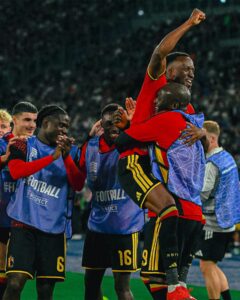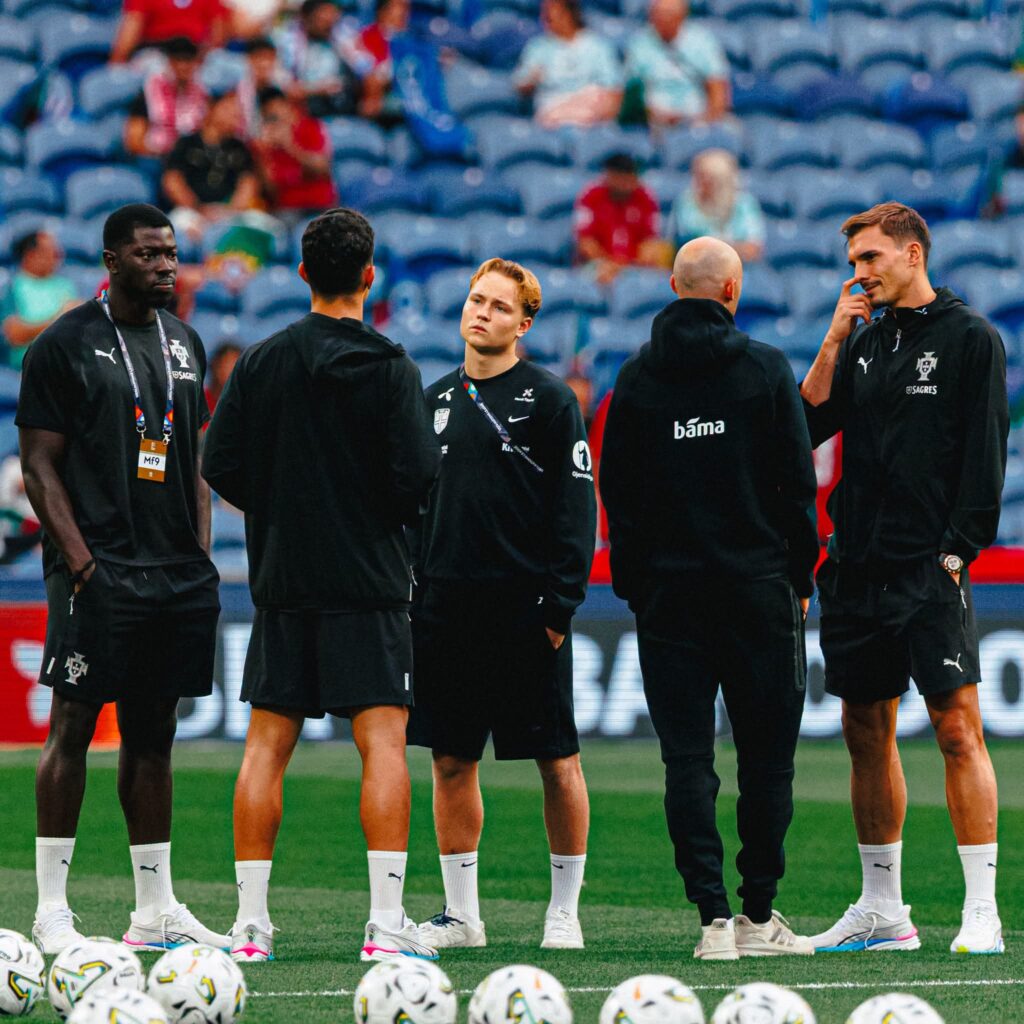
Samuel Suares, Andreas Schjelderup, Joao Palhinha seen during UEFA Nations League teams of Portugal and Norway Estadio do dragao Luis Loureiro/Ball Raw Images PT Porto Estadio do Dragao Portugal Copyright: xLuisxLoureirox lloureiroPORNORW-4280
Benfica have sent a simple but powerful message to their supporters after a demanding international break: “Reunited.”
The Portuguese giants have welcomed members of their squad back together after an unusually busy period in which a remarkable 17 of the club’s 27 professional players were called up by their respective national teams.
The image shared by Benfica shows several members of the squad back together at the training ground, marking the end of a period in which the team was spread across different countries and competitions.
For Benfica, the timing could hardly be more important.
The Eagles are entering another crucial part of the season, with domestic and European football both approaching. After a difficult 3-1 defeat against FC Porto, Marco Silva’s side now has the opportunity to regroup, recover and prepare for a demanding run of fixtures.
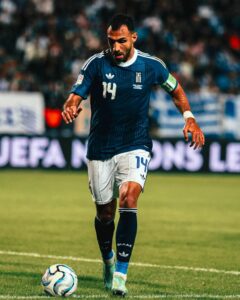
Among the players returning from international duty is Vangelis Pavlidis, who has just completed a demanding spell with Greece. The Benfica striker started all of Greece’s first four Nations League matches during this international window and captained his country in the 2-2 draw against the Netherlands in Thessaloniki.
The international break may be over, but the pressure on Benfica is only beginning to increase.
The next challenge is Vitória SC at the Estádio da Luz on October 11, followed just four days later by a Europa League meeting with Celtic.
For Benfica, the “Reunited” message is therefore more than a social-media caption.
It represents the beginning of the next chapter.
Benfica’s squad finally comes back together
The international break created a unique situation for Benfica.
According to the club’s official information, 17 of the 27 players in the professional squad were called up by their national teams during the September-October FIFA window. Those players represented 12 different national teams and age groups.
That is a significant portion of the squad.
It meant that Benfica’s coaching staff had to work with a heavily reduced group while many of the club’s most important players were away representing their countries.
Players travelled to different parts of Europe and beyond.
Some played Nations League matches.
Others represented youth national teams.
Some started every match.
Others came off the bench.
And some remained unused substitutes.
But now the international commitments are coming to an end, and Benfica can begin putting the pieces back together.
That is the story behind the club’s “Reunited” post.
After weeks of separation, the players are once again wearing Benfica training gear, sharing the same pitch and preparing for the same objective.
That objective is simple: win football matches for Benfica.
Pavlidis returns after a demanding international spell
One of the most important players returning to the Benfica setup is Vangelis Pavlidis.
The Greek striker had a particularly demanding international schedule.
Before the international window began, Benfica confirmed that Pavlidis had been selected for Greece’s first four Nations League matches.
His schedule included:
- Serbia vs Greece on September 24
- Germany vs Greece on September 27
- Greece vs Netherlands on October 1
- Greece vs Germany on October 4
All four matches were part of the Nations League Group A2 programme.
That meant Pavlidis had almost no opportunity for an extended period of rest.
He was required to travel, train with the Greek national team, play competitive international football and then prepare for another match only a few days later.
For a striker operating at the highest level, that is a significant workload.
Yet Pavlidis remained an important figure for Greece throughout the period.
The clearest indication of his importance came against the Netherlands.
He did not simply start the match.
He captained Greece.
Pavlidis wore the captain’s armband against the Netherlands
On October 1, Greece faced the Netherlands at Toumba Stadium in Thessaloniki.
Pavlidis was named in the starting lineup and was given the captain’s armband.
The match ended 2-2 after a dramatic encounter in which Greece surrendered a two-goal advantage.
Benfica later confirmed that Pavlidis started the match, captained Greece and was substituted in the 71st minute.
The match itself was one of the most entertaining games of the international window.
Greece took control early.
Fotis Ioannidis opened the scoring before Giorgos Masouras doubled the advantage shortly before half-time.
The Netherlands responded after the break.
Virgil van Dijk pulled one goal back before Tijjani Reijnders completed the comeback late in the match.
The final score was 2-2.
For Pavlidis, it was an important personal moment despite the fact that he did not get his name on the scoresheet.
Wearing the captain’s armband for Greece showed the level of trust placed in the Benfica striker.
Pavlidis did not score against the Netherlands
There has been some confusion around Pavlidis and the Greece-Netherlands match, particularly because of social-media posts circulating around the game.
It is important to make the distinction clear.
Pavlidis did not score in the 2-2 draw against the Netherlands.
The goals were scored by Fotis Ioannidis and Giorgos Masouras for Greece, while Virgil van Dijk and Tijjani Reijnders scored for the Netherlands.
Pavlidis was nevertheless involved in an early incident that attracted attention.
A Greek goal was disallowed after Pavlidis was judged to have interfered with goalkeeper Bart Verbruggen while in an offside position.
So while Pavlidis did not score, his positioning played a role in one of the game’s early talking points.
That is an important distinction for Benfica supporters and for anyone following the striker’s international campaign.
Another start for Greece against Germany
Pavlidis did not have to wait long before returning to action.
Just three days after the Netherlands match, Greece faced Germany again.
The Benfica striker was once more named in the starting XI.
This time, however, his involvement lasted only the first half.
Pavlidis was replaced at the interval, with Greece eventually drawing 0-0 with Germany.
Benfica confirmed that Pavlidis started the match but was substituted at half-time.
That brought his international programme to an end.
Four matches.
Four starts.
A captaincy.
And a significant amount of travelling and training.
Now the striker can turn his full attention back to Benfica.
Benfica had 17 internationals away
The story is not only about Pavlidis.
The scale of Benfica’s international involvement during this window was enormous.
The club confirmed that 17 of its 27 professional players were called up by national teams.
That included players representing Portugal, Ukraine, Norway, Denmark, Luxembourg, Poland, Belgium, Greece, Argentina, Australia and Portugal’s youth teams.
The list included:
Samuel Soares, Tomás Araújo and João Palhinha for Portugal.
Anatoliy Trubin and Georgiy Sudakov for Ukraine.
Fredrik Aursnes and Andreas Schjelderup for Norway.
Alexander Bah for Denmark.
Leandro Barreiro for Luxembourg.
Jakub Kamiński for Poland.
Dodi Lukebakio for Belgium.
Vangelis Pavlidis for Greece.
Gianluca Prestianni for Argentina.
Alessandro Circati for Australia.
And several players representing Portugal’s Under-21 and Under-19 teams.
For Marco Silva, this created a difficult situation.
The manager could not work with his complete squad for most of the international window.
Instead, the club had to wait for its players to return.
Now that process has started.
The importance of the “Reunited” message
The word Benfica chose for the social-media post is simple:
Reunited.
But in the context of the club’s current situation, the word carries considerable meaning.
For almost two weeks, Benfica’s players have been separated.
They have trained under different coaches.
They have followed different tactical instructions.
They have travelled thousands of kilometres.
They have played different competitions.
And some have even faced Benfica teammates as opponents.
Now all of that changes.
The players are once again part of the same group.
They train under Marco Silva.
They wear the same Benfica colours.
They prepare for the same fixtures.
And they share the same objective.
That is why the photograph is significant.
It is not simply a picture of footballers standing together.
It is a symbol of Benfica returning to normality after an unusually busy international period.
Marco Silva faces an important period
The return of the international players is particularly important for Marco Silva.
The Benfica head coach is now preparing for a period in which the club has very little room for mistakes.
Before the international break, Benfica suffered a 3-1 defeat against FC Porto.
It was a damaging result in a major Portuguese football rivalry.
The loss means Benfica now needs a strong reaction.
Fortunately for Silva, the international break provided some time away from the immediate pressure of the result.
But now the players are returning.
The excuses disappear.
The next match is approaching.
And Benfica must respond.
The first opportunity comes against Vitória SC.
Vitória SC awaits at the Estádio da Luz
Benfica’s next scheduled domestic fixture is against Vitória SC on Sunday, October 11.
The match is scheduled for 18:00 at the Estádio da Luz.
It will be an important match for several reasons.
First, Benfica needs three points.
Second, the team needs to restore confidence after the defeat to Porto.
Third, Silva needs to see how effectively his internationals have reintegrated into the squad.
And fourth, the match provides Pavlidis with another opportunity to make an impact.
For a striker, returning from international duty and immediately producing a strong performance for his club can be hugely important.
Pavlidis will want to do exactly that.
Pavlidis remains one of Benfica’s most important attacking players
Since arriving at Benfica from AZ, Pavlidis has carried significant expectations.
The Greek striker had already established himself as one of the most productive forwards in the Netherlands before moving to Portugal.
At AZ, he developed a reputation as a reliable goalscorer.
That reputation followed him to Lisbon.
Benfica did not sign Pavlidis simply to provide depth.
The club expected him to contribute goals.
That expectation remains.
And whenever Benfica enters an important run of matches, attention naturally turns towards the centre-forward.
Can Pavlidis score?
Can he create chances?
Can he hold up the ball?
Can he occupy defenders?
Can he provide the decisive moment?
Those questions will once again surround him when Benfica return to domestic action.
The Greek striker has experience in the Netherlands
There is an interesting connection between Pavlidis and Dutch football.
Before moving to Benfica, the striker spent several seasons in the Netherlands.
He played for Willem II before joining AZ.
It was at AZ that he became one of the Eredivisie’s most recognised forwards.
His performances eventually attracted attention from Benfica.
The move to Portugal represented the next major step in his career.
Today, Pavlidis is not only a Benfica striker but also an established international for Greece.
His experience in the Netherlands, Portugal and international football has given him an unusually broad football background.
That experience could become valuable as Benfica enters a demanding period.
A player who knows how to handle pressure
Playing for Benfica comes with enormous pressure.
The club is one of Portugal’s biggest institutions.
The supporters expect victories.
They expect attacking football.
They expect trophies.
And they expect their forwards to score.
Pavlidis has already experienced that pressure.
He knows that a striker can be praised one week and questioned the next.
He also knows that the easiest way to silence criticism is to score goals.
That is likely to be his focus when he returns to the Benfica starting lineup.
Benfica’s other internationals are also returning
While Pavlidis has attracted attention, Benfica’s other returning internationals are equally important.
One of the most interesting situations involved João Palhinha.
The midfielder represented Portugal during the international period.
On October 4, Portugal faced Norway.
That created an unusual situation because two Benfica players, Fredrik Aursnes and Andreas Schjelderup, were on the Norwegian side.
Palhinha started for Portugal and played until the 63rd minute.
Aursnes and Schjelderup started for Norway and completed the full 90 minutes.
Portugal won 2-1.
Now the three players must return to Benfica and become teammates again.
That is one of the strange realities of international football.
Players can spend 90 minutes trying to beat each other.
A few days later, they are back in the same dressing room.
Aursnes and Schjelderup return with valuable minutes
The Norwegian pair also had a busy period.
Both Aursnes and Schjelderup started against Wales on October 1.
Aursnes was substituted at half-time, while Schjelderup played until the 75th minute.
Norway eventually lost 2-1 to Wales.
Then both players returned to the starting lineup against Portugal.
That represents a significant amount of international football in a short period.
For Benfica, their physical condition will therefore be carefully monitored.
But from a sporting perspective, the minutes could also benefit them.
Players often return from international duty with greater confidence after competing against high-level opposition.
Tomás Araújo also featured for Portugal
Tomás Araújo was another Benfica player involved during the international period.
He made a late appearance for Portugal against Denmark, entering in stoppage time as Portugal secured a 4-2 victory in Copenhagen.
Meanwhile, João Palhinha and Samuel Soares were unused substitutes in that match.
The international experience is valuable for young players such as Araújo.
Being around the senior national team provides exposure to a different environment and a different level of competition.
When he returns to Benfica, he brings that experience back into the club environment.
Trubin and Sudakov represent Ukraine
Benfica also had two important Ukrainian internationals involved during the window.
Anatoliy Trubin has become an important goalkeeper for both Benfica and Ukraine.
Georgiy Sudakov is another player whose development is being closely followed.
Their international commitments meant that Benfica’s coaching staff had to plan without them for much of the break.
Their return is therefore another important piece of the puzzle for Marco Silva.
The international break was not really a break for Benfica
For many football supporters, an international break means a temporary pause.
For Benfica, however, it was anything but a pause.
The club still had to monitor its players.
Medical and performance staff remained focused on the condition of those away with their countries.
Coaches had to prepare for the eventual return.
And the club had to continue planning for the next fixtures.
This is one of the challenges faced by elite clubs.
The more international-quality players a team has, the greater the disruption during FIFA windows.
Benfica experienced that situation on a large scale.
Seventeen players means almost an entire starting XI and bench
Think about what 17 international call-ups means.
It is not just one or two important players missing.
It is enough players to construct a complete starting lineup and still have several substitutes available.
That makes regular team training extremely difficult.
Marco Silva would have been unable to replicate his preferred tactical setup with all the necessary players.
He could work on individual development.
He could work with the remaining group.
He could analyse previous matches.
But the full tactical unit was unavailable.
Now that situation is changing.
Benfica can finally work on tactical details
The return of the internationals allows Silva to focus on details that cannot easily be worked on during an international break.
For example, the coach can work on pressing structures.
He can improve build-up patterns.
He can rehearse attacking combinations.
He can work on set pieces.
He can correct defensive positioning.
And most importantly, he can reconnect players who have spent the past two weeks playing in completely different systems.
That is where the “Reunited” message becomes especially relevant.
The players are not just physically back.
They need to become a team again.
Pavlidis must reconnect with Benfica’s attack
For Pavlidis, this is particularly important.
A striker depends heavily on the players behind him.
His movement must be understood by the midfielders.
His runs must be recognised by the wingers.
His positioning must be synchronised with the full-backs.
And the players around him must know when he wants the ball to his feet and when he wants it played into space.
Those relationships develop through training.
The international break interrupts them.
Now they can be rebuilt.
Benfica’s next phase will test the squad
The upcoming fixtures mean Benfica cannot afford to take a long time to rediscover its rhythm.
After Vitória SC, Celtic arrive in Lisbon for a Europa League match on October 15.
Then Benfica are scheduled to face Omonia Nicosia away on October 22.
That creates a demanding sequence.
Domestic football.
European football.
Travel.
Recovery.
Training.
Then another match.
This is why squad depth will become increasingly important.
Celtic provides another major challenge
The Europa League meeting with Celtic is particularly interesting.
European nights at the Estádio da Luz traditionally carry a special atmosphere.
Benfica will want to make full use of home advantage.
But Celtic will arrive with its own ambitions.
For Silva, European matches also provide a chance to assess his squad against a different style of football.
Pavlidis could play an important role.
His experience in European competition is another reason Benfica signed him.
Big European matches can define attacking players.
One decisive goal can change the narrative around an entire campaign.
The pressure on Benfica will increase
The further the season progresses, the more important every result becomes.
Early-season points are valuable.
But later in the campaign, every dropped point can have consequences.
Benfica therefore needs to build momentum now.
A strong performance against Vitória SC would provide the perfect response to the Porto defeat.
A positive result against Celtic would then provide momentum in Europe.
That is the ideal scenario.
And Pavlidis will be expected to contribute.
“Reunited” also sends a message to Benfica supporters
There is another reason the post matters.
Football clubs use social media to communicate directly with supporters.
A short caption such as “Reunited” creates an emotional connection.
It tells fans that the squad is back together.
It creates anticipation.
It reminds supporters that the next match is approaching.
And it reinforces the idea that the club is moving forward.
After a disappointing result, that can be particularly useful.
The message is not about the past.
It is about what comes next.
The Porto defeat must now be forgotten
Benfica’s 3-1 defeat against Porto was undoubtedly disappointing.
But elite football teams cannot spend weeks analysing one defeat.
They have to respond.
That is especially true for Benfica.
The club is competing for major honours and cannot afford to allow one poor result to become a sequence of poor results.
The international break has given everyone time to reset.
Now the response must come on the pitch.
Pavlidis can play a major role in that response
One of the easiest ways for Benfica to regain momentum would be for its centre-forward to start scoring regularly again.
Pavlidis has the profile for that.
He is experienced.
He understands the demands of leading the line.
And he has already demonstrated that he can perform at a high level in different leagues.
The next few matches will be another opportunity.
If he finds the net against Vitória SC, the conversation will immediately shift.
Instead of discussing the international break, people will be discussing Pavlidis’s next goal.
That is how quickly football changes.
Benfica need more than goals from Pavlidis
At the same time, the striker’s role cannot be reduced to scoring.
Modern centre-forwards are expected to contribute in many ways.
They must press defenders.
They must hold up the ball.
They must create space for attacking teammates.
They must make intelligent runs.
They must help the team advance up the pitch.
Pavlidis has developed those aspects of his game during his career.
That makes him valuable even when he does not score.
The Greece experience could help him
Playing for Greece as captain against the Netherlands was another step in Pavlidis’s development.
Captaincy brings responsibility.
The player has to communicate.
He must set an example.
He must remain focused during difficult moments.
And he has to deal with the emotional pressure of representing his country.
Those experiences can make a player stronger.
When Pavlidis returns to Benfica, Silva may benefit from the confidence and leadership he gained during the international period.
Benfica’s dressing room will be busy again
The return of so many players also changes the atmosphere around the training ground.
During the international break, the remaining Benfica players worked in a smaller group.
Now the dressing room is becoming crowded again.
Players who have spent weeks apart can catch up.
They can discuss their national-team experiences.
They can joke about teammates facing each other.
They can talk about the matches.
And then they can return their attention to Benfica.
That is an important part of team chemistry.
International football creates different pressures
National-team football is different from club football.
With a national team, players may spend only a few days together before a competitive match.
At Benfica, they work together throughout the season.
That difference means players returning from international duty need to switch mentally as well as physically.
They have to stop thinking about their national team.
Now the club comes first.
For Pavlidis, that means Greece is temporarily put aside.
Benfica becomes the priority again.
The timing of the return is crucial
The timing could hardly be more significant.
Benfica have just experienced a setback against Porto.
The club has several important fixtures coming.
And the squad is now returning from a physically demanding international period.
That creates a delicate balance.
The players need enough recovery.
But they also need enough training.
The coaching staff must find the right solution.
Benfica’s medical team will also have a key role
With so many players involved internationally, injury management becomes crucial.
A player may return feeling tired but healthy.
Another may return with a minor knock.
Another may have accumulated too many minutes.
The medical and performance teams have to assess each player individually.
There is no single recovery plan that works for everyone.
Pavlidis, for example, has had a different workload from a player who remained on the bench throughout the international window.
That difference matters.
Squad rotation could become important
With Benfica facing both domestic and European matches, Silva may need to rotate.
Pavlidis cannot be expected to play every minute of every match indefinitely.
The same applies to Aursnes, Palhinha, Schjelderup and the rest of the international contingent.
Rotation does not necessarily mean a player has lost his place.
It can simply be good squad management.
A team competing on multiple fronts needs fresh players.
Benfica need everyone ready
That is perhaps the biggest message behind the “Reunited” image.
Benfica need everyone.
Not just the stars.
Not just Pavlidis.
Not just the Portuguese internationals.
Everyone.
The season will be long.
There will be injuries.
There will be suspensions.
There will be difficult away games.
There will be European nights.
There will be periods when some players are out of form.
A successful team needs depth.
Benfica now have the opportunity to rebuild that collective strength.
The next few training sessions could be decisive
The training sessions leading up to the Vitória SC match will provide important clues.
Will Pavlidis immediately return to the starting XI?
Will Silva rotate some of his internationals?
Will players who performed well for their countries earn opportunities?
Will the coach change the system?
Those questions will gradually be answered.
But one thing is certain.
The coaching staff will have far more options than they had during the international window.
Pavlidis and the Benfica fans
The relationship between Pavlidis and Benfica supporters remains an interesting part of the story.
The fans expect goals.
The striker knows that.
But supporters also recognise effort.
If Pavlidis works hard, presses defenders and creates opportunities, the crowd can appreciate his contribution even if the ball does not go into the net.
A goal, however, always makes things easier.
That is the reality for any Benfica number nine.
The road ahead is demanding
The next few weeks could shape Benfica’s season.
Domestic points are available.
European points are available.
Momentum can be created.
Confidence can be restored.
Or, if results go badly, pressure can increase rapidly.
The club therefore needs its best players ready.
Pavlidis is certainly among them.
Why the “Reunited” picture matters
The image may not contain a tactical diagram.
It may not announce a signing.
It may not reveal a major injury update.
But it tells an important story.
Benfica’s players are back together.
After an international period that saw 17 of the club’s 27 professional players called up, the squad is gradually returning to normal.
For a club with major ambitions, that matters.
The next phase of the season cannot be approached with a divided squad.
The team needs to train together.
It needs to recover together.
It needs to prepare together.
And ultimately, it needs to win together.
Pavlidis now turns his attention back to Benfica
For Pavlidis, the international chapter has closed for now.
He represented Greece in four Nations League matches.
He started against the Netherlands as captain.
He played the first half against Germany in the final match of the international period.
Now he returns to Lisbon.
His focus shifts from Greece to Benfica.
From international football to club football.
From the national team dressing room back to the Benfica dressing room.
And from the Nations League to the Primeira Liga and Europa League.
That transition will be important.
Benfica’s message is clear
The message from the club could not be simpler.
Reunited.
The internationals are returning.
The training ground is becoming busy again.
The squad is coming together.
And the next challenge is already waiting.
Vitória SC.
Then Celtic.
Then Omonia Nicosia.
The schedule will not slow down.
A fresh start after the international break
Every international break creates a kind of reset.
Players leave their clubs with one set of responsibilities.
They return with another.
For Benfica, this reset comes at exactly the right time.
The Porto defeat can now become part of the past.
The players have had time to think.
The coaching staff has had time to analyse.
And the squad is now reunited.
The next match provides the answer.
Benfica must turn togetherness into results
A photograph alone cannot win football matches.
“Reunited” is a nice message.
But ultimately, supporters want results.
They want goals.
They want victories.
They want trophies.
Benfica now have to transform the positive feeling around the squad into performances on the pitch.
That starts against Vitória SC.
What supporters will expect from Pavlidis
When the teams walk out at the Estádio da Luz, attention will naturally turn to the Benfica attack.
If Pavlidis starts, supporters will expect him to lead the line.
They will expect movement.
They will expect pressing.
They will expect chances.
And, above all, they will hope for goals.
For Pavlidis, that is nothing new.
He has already experienced the expectations of playing for a major club.
Now he has another chance to deliver.
The European challenge adds another layer
The Celtic match will be another major test.
European football demands concentration.
One mistake can change a match.
One moment of quality can win it.
That is where experienced players become especially valuable.
Pavlidis has played European football throughout his career.
His understanding of high-pressure matches can be important for Benfica.
Benfica have reasons for optimism
Despite the recent defeat to Porto, there are reasons for Benfica supporters to remain optimistic.
The team has quality.
The squad has depth.
The club has experienced internationals.
And the players are now coming back together.
The season is still developing.
One defeat does not define an entire campaign.
The response does.
The next chapter begins now
The “Reunited” picture captures that perfectly.
The international period is finished for most of the Benfica players.
The squad is returning.
The coaching staff can resume normal preparations.
The players can focus exclusively on Benfica.
And Pavlidis can once again concentrate on scoring goals for the Eagles.
The coming weeks will reveal whether Benfica can turn that reunion into momentum.
Final verdict: Benfica’s reunion comes at the perfect time
Benfica’s decision to caption the photograph “Reunited” may have been brief, but the message behind it is significant.
The Portuguese giants have just completed one of the busiest international windows imaginable, with 17 of their 27 professional players called up to national teams across 12 different international representations.
Vangelis Pavlidis was one of the most prominent names in that group.
The Greek striker featured in all four of Greece’s Nations League fixtures during the window. He started against the Netherlands and wore the captain’s armband in the 2-2 draw in Thessaloniki before being substituted in the 71st minute.
Three days later, he started again against Germany and played the first half before being replaced at half-time in a 0-0 draw.
Now his international responsibilities are temporarily over.
His attention returns to Benfica.
The same applies to João Palhinha, Fredrik Aursnes, Andreas Schjelderup, Tomás Araújo and the other Benfica players who represented their countries.
They are coming back to the same dressing room.
The same training ground.
The same badge.
The same objective.
And they could hardly have returned at a more important time.
Benfica need to respond to the 3-1 defeat against FC Porto.
They need to prepare for Vitória SC at the Estádio da Luz on October 11.
They then face Celtic in the Europa League on October 15 before another European trip to Omonia Nicosia on October 22.
That schedule will demand everything from Marco Silva’s squad.
It will demand fitness.
It will demand concentration.
It will demand tactical discipline.
And it will demand goals.
That is where Pavlidis comes in.
The Greek striker now has the opportunity to put the international period behind him and focus completely on Benfica.
He did not score against the Netherlands despite being involved in an early controversial moment, and he did not find the net against Germany either.
But his importance to Greece was demonstrated by his captaincy and his selection for both matches.
Now he must bring that confidence back to Lisbon.
For Benfica supporters, the image of the players back together is therefore more than a casual social-media post.
It represents the return of the team.
It represents the end of the disruption caused by international football.
And it represents the beginning of another crucial stage of the season.
The players are reunited.
The supporters are waiting.
The fixtures are coming.
And for Pavlidis and Benfica, the real response will now have to come on the pitch.