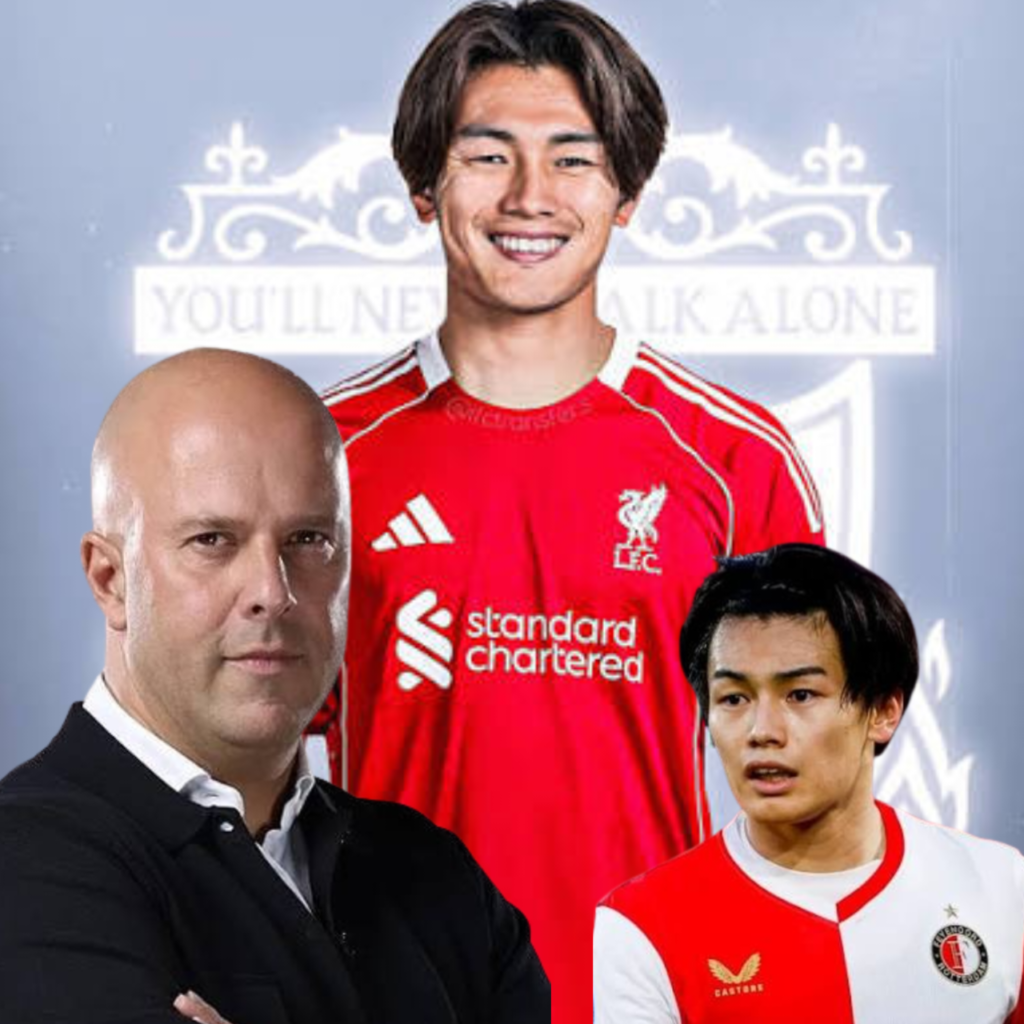
The summer transfer window has not officially opened yet, but the noise surrounding is already impossible to ignore. Across England, the Netherlands, and Japan, discussions are growing louder over a move that many supporters believe would carry both footballing logic and emotional symbolism. At the center of those conversations stands and his reported determination to reunite with former striker .
For Liverpool supporters, this is about far more than another transfer rumor. It represents the possibility of a new chapter under Slot — a chapter shaped by trust, familiarity, attacking intensity, and players who fully understand the Dutch manager’s tactical demands. For Feyenoord fans, meanwhile, the speculation brings mixed emotions: pride that another Eredivisie talent is attracting elite European attention, but also sadness at the possibility of losing one of the club’s most technically gifted forwards.
Sources close to Dutch football circles continue to insist that Slot remains a huge admirer of Ueda’s intelligence, movement, and mentality. Although Liverpool’s summer plans are expected to involve multiple major targets, insiders believe the Japanese international has quietly emerged as a realistic option amid the club’s wider attacking rebuild.
The potential reunion has quickly become one of the most emotional storylines of the upcoming transfer window.
A Relationship Built in Rotterdam
To fully understand why Slot reportedly wants Ueda at Liverpool, it is necessary to revisit their time together in Rotterdam.
When Ueda arrived at Feyenoord, expectations were already high. The Japanese striker had built an impressive reputation with his movement inside the penalty area, his calm finishing, and his remarkable work ethic. However, adapting to Dutch football was never going to be straightforward. The Eredivisie demands intensity, physicality, tactical awareness, and relentless pressing from forwards.
Slot believed Ueda could thrive in that environment.
From the beginning, the manager viewed the striker as far more than a traditional penalty-box finisher. Slot saw a forward capable of linking midfield and attack, creating space for wide players, and leading the press with discipline and intelligence. Training sessions reportedly focused heavily on positioning, movement between defenders, and coordinated pressing triggers.
Over time, the relationship between coach and player strengthened significantly.
Those inside Feyenoord’s dressing room often spoke about Slot’s patience with Ueda. Unlike many managers who demand immediate results, Slot understood the adaptation period required for players arriving from different football cultures. He continued encouraging Ueda publicly even during difficult moments, insisting the striker possessed qualities that would eventually become decisive for the team.
That faith mattered enormously.
Ueda responded by gradually becoming one of Feyenoord’s most dangerous attacking weapons. His understanding of space improved dramatically, his confidence in front of goal increased, and his chemistry with teammates became more natural with every passing month.
Now, with Slot beginning a major rebuilding project at Liverpool, many believe he sees Ueda as a player perfectly suited to accelerate tactical continuity inside the squad.
Liverpool Preparing for a Massive Summer
At , this summer is expected to be one of the most transformative periods in recent club history.
The transition into the Slot era already represents a major cultural and tactical shift. While the club remains ambitious domestically and in Europe, there is growing recognition that several parts of the squad require renewal.
Liverpool’s attacking department, in particular, faces uncertainty.
Questions continue surrounding long-term squad balance, injury management, tactical versatility, and depth across multiple competitions. The club’s recruitment department has reportedly spent months evaluating players capable of fitting Slot’s aggressive pressing structure while also possessing technical intelligence in possession.
That is precisely why Ueda’s name continues to surface.
Unlike some traditional strikers who depend heavily on service, Ueda thrives in dynamic attacking systems. He presses aggressively, drifts intelligently into channels, and constantly looks to destabilize defensive structures through movement rather than physical dominance alone.
Those characteristics mirror many of the principles Slot wants to strengthen at Liverpool.
Importantly, Ueda also represents a financially realistic target compared to several elite strikers currently commanding enormous transfer fees. Liverpool are expected to spend significantly this summer, but club executives remain cautious about market inflation.
A move for Ueda could therefore provide tactical value, squad depth, and long-term upside without requiring an extraordinary financial gamble.
Why Slot Trusts Him
Managers often return to players they deeply trust.
Throughout football history, coaches repeatedly attempt reunions with footballers who understand their philosophy completely. Familiarity reduces adaptation risk, accelerates implementation of tactical systems, and strengthens dressing-room culture.
Slot appears to believe Ueda fits that category.
At Feyenoord, the striker demonstrated not only technical growth but also psychological resilience. He handled criticism professionally, adapted to tactical demands, and consistently showed willingness to improve.
That mentality reportedly impressed Slot enormously.
Liverpool’s dressing room is known for its competitive intensity. Every training session operates at an elite standard, and players unable to cope mentally often struggle quickly. Slot likely understands that importing players already familiar with his expectations could ease the transition into his reign.
Ueda’s personality may therefore matter as much as his footballing ability.
Observers in Dutch football frequently describe him as humble, disciplined, calm under pressure, and deeply team-oriented. Those traits align strongly with the culture Liverpool have attempted to preserve in recent years.
Supporters may initially focus on goals and assists, but internally, managers often prioritize professionalism and adaptability just as highly.
Feyenoord Fans Torn Between Pride and Fear
In Rotterdam, reaction to the rumors has been emotional.
Many Feyenoord supporters remain deeply attached to Ueda, particularly because of the persistence he showed during difficult periods. Fans watched him battle for consistency, adapt to a demanding tactical system, and gradually become an increasingly influential figure.
That journey created a strong emotional connection.
For some supporters, the possibility of seeing another Feyenoord player move to a global giant like Liverpool represents validation of the club’s development structure. Under Slot and Feyenoord’s modern recruitment model, the Rotterdam side has increasingly become one of Europe’s most respected talent platforms.
However, pride does not erase concern.
Losing important players every summer creates instability. Supporters understand the financial realities of modern football, but they also fear constant rebuilding could eventually weaken Feyenoord’s competitive ambitions both domestically and in Europe.
The emotional dimension becomes even stronger because of Slot’s history with the club.
Many Feyenoord fans still admire the manager enormously for restoring belief, discipline, and attacking identity. Yet seeing him potentially return for one of the club’s most important forwards would undoubtedly create conflicting feelings.
Some fans would celebrate Ueda’s opportunity. Others would view the move as another painful reminder of the growing financial gap between the Eredivisie and the Premier League.
Ueda’s Rise Beyond Expectations
What makes the story particularly fascinating is how dramatically Ueda’s reputation has evolved.
When he first arrived in Europe, there were understandable doubts regarding adaptation speed. Football transitions from Asia to Europe can be difficult even for technically gifted players. Differences in tempo, physicality, tactical complexity, and media scrutiny often create enormous pressure.
Yet Ueda continued progressing.
His movement inside the penalty area became sharper. His link-up play improved significantly. Most importantly, he learned how to influence matches even when not scoring.
Modern elite football increasingly values multifunctional forwards. Managers no longer simply want strikers waiting inside the box for service. They want pressing leaders, tactical disruptors, intelligent runners, and players capable of facilitating attacking fluidity.
Ueda developed many of those attributes at Feyenoord.
By the end of recent campaigns, analysts in the Netherlands regularly highlighted his improved decision-making and positional awareness. His understanding of pressing structures became particularly impressive, allowing him to fit seamlessly into high-energy systems.
That tactical maturity is almost certainly one reason Slot continues valuing him so highly.
Liverpool’s Japanese Connection
Another intriguing dimension involves Liverpool’s growing global strategy.
The club remains one of the most internationally recognized institutions in football, and expanding influence in Asian markets continues carrying enormous commercial importance. Signing a player of Ueda’s profile would naturally increase attention from Japanese supporters and sponsors.
However, sources insist the interest is football-driven first.
Liverpool are aware that purely commercial transfers rarely succeed long-term. The club’s recruitment structure under previous regimes became respected specifically because decisions prioritized tactical fit and character rather than marketing value alone.
Still, the global excitement surrounding a Japanese international joining Liverpool would undoubtedly be enormous.
Japanese football supporters have passionately followed the success of players across Europe in recent years. The rise of technically gifted Japanese internationals in elite leagues has transformed international perceptions dramatically.
Ueda joining Liverpool under Slot would likely become one of the biggest football stories in Japan.
Tactical Possibilities at Anfield
From a football perspective, the potential tactical combinations are extremely interesting.
Slot’s systems typically prioritize fluid movement, coordinated pressing, quick combinations, and positional rotations. Rather than relying on static attacking structures, his teams constantly attempt to destabilize opponents through movement and overloads.
Ueda could fit naturally into that approach.
His off-ball intelligence allows wide forwards and attacking midfielders to exploit spaces created by defensive shifts. He also works tirelessly defensively — an essential requirement for Slot’s aggressive pressing principles.
Liverpool supporters have already begun debating how the Japanese striker might integrate alongside the club’s current attacking options.
Some believe he could become a rotational striker in multiple competitions. Others think Slot may envision him as a more central tactical figure than outsiders currently expect.
The reality likely depends on Liverpool’s broader transfer activity.
If major departures occur in attack, opportunities for Ueda could expand significantly. Conversely, if the club retains most senior forwards while adding only selective reinforcements, his role may initially focus on tactical flexibility and squad depth.
Either way, Slot’s trust in him appears genuine.
The Financial Equation
Transfer negotiations are never purely emotional.
Even if Slot strongly desires the reunion, multiple financial variables will shape whether a deal becomes realistic. Feyenoord understand Ueda’s value both on the pitch and commercially, meaning Liverpool would likely need to present a substantial offer.
Fortunately for Liverpool, Feyenoord traditionally operate pragmatically when major bids arrive.
The Dutch club has increasingly accepted that sustainable success requires balancing competitiveness with profitable player sales. Recent years demonstrated the effectiveness of that strategy, allowing Feyenoord to strengthen infrastructure, recruitment systems, and long-term financial stability.
Still, losing Ueda would not be easy.
Finding strikers capable of combining technical quality, pressing intensity, and tactical intelligence is increasingly difficult in modern football. Feyenoord would almost certainly need to enter the market aggressively to secure an adequate replacement.
That could complicate negotiations.
Liverpool may prefer a reasonable fee reflecting squad-rotation expectations, while Feyenoord may insist Ueda’s growing importance justifies premium valuation.
As always, much may depend on the player himself.
Would Ueda Want the Move?
For any transfer to happen, the player must believe completely in the project.
Reports suggest Ueda remains extremely respectful toward Feyenoord and grateful for the role the club played in his European development. However, opportunities to join clubs like Liverpool do not emerge frequently.
Playing in the Premier League under a manager who already trusts him could prove irresistible.
The emotional aspect of reuniting with Slot also matters significantly. Footballers often perform best under coaches who understand them deeply. Slot helped guide one of the most important developmental periods of Ueda’s European career.
That history could heavily influence any eventual decision.
Additionally, Liverpool’s ambitions remain enormous despite ongoing transition. The possibility of competing for Premier League titles, Champions League success, and global recognition represents a dream scenario for many players.
For Ueda, such a move could elevate his international profile to unprecedented levels.
Competition for Places
Of course, joining Liverpool would also bring major challenges.
Competition inside the squad is relentless. Expectations from supporters and media remain extraordinarily high. Every missed chance, every difficult performance, and every tactical adjustment receives global scrutiny.
Ueda would need resilience.
However, those who followed his journey at Feyenoord believe he possesses precisely that quality. His development path has rarely been straightforward, yet he repeatedly demonstrated patience and professionalism.
That emotional maturity may become one of his greatest strengths if the transfer materializes.
Liverpool supporters also tend to embrace hardworking, selfless players who fight relentlessly for the badge. Ueda’s playing style and personality could therefore help him establish a strong connection with fans relatively quickly.
Arne Slot’s Vision Becoming Clearer
Perhaps the biggest revelation from the rumors is what they suggest about Slot’s long-term vision for Liverpool.
Many expected the Dutch manager to pursue only globally established superstars after arriving in England. Instead, early indications imply he may prioritize tactical compatibility and collective structure above celebrity status.
That approach mirrors his work at Feyenoord.
Slot consistently transformed players into elite performers through coaching clarity, positional discipline, and intelligent recruitment. Rather than relying exclusively on expensive stars, he built systems maximizing collective efficiency.
Targeting Ueda would align perfectly with that philosophy.
It would signal that Liverpool’s rebuild under Slot may focus heavily on players capable of executing precise tactical instructions, maintaining relentless work rates, and functioning within a fluid attacking structure.
In modern football, that approach increasingly proves more sustainable than simply accumulating famous names.
Dutch Football Watching Closely
Across the Netherlands, the speculation has generated enormous interest.
Dutch football observers recognize that another successful Feyenoord-to-Liverpool connection would further strengthen the Eredivisie’s reputation as a development league for elite European clubs.
Slot’s success already elevated international respect for Dutch coaching methods. If he now begins recruiting former Eredivisie players into one of Europe’s biggest clubs, attention toward the league could grow even further.
That carries implications beyond Feyenoord.
Other Dutch clubs may benefit from increased scouting attention, improved transfer valuations, and stronger international visibility. At the same time, however, concerns persist about the Eredivisie increasingly functioning as a supplier league unable to retain top talent long-term.
The Ueda story therefore represents both opportunity and challenge for Dutch football.
Supporters Already Dreaming
On social media, excitement continues building rapidly.
Liverpool supporters have already started analyzing clips of Ueda’s movement, pressing intensity, and finishing ability. Feyenoord fans continue debating whether the club should resist any approach regardless of financial benefit.
Japanese football supporters, meanwhile, are watching developments with enormous anticipation.
The possibility of another Japanese player starring at one of world football’s most iconic clubs carries immense emotional significance. Many fans believe Ueda’s disciplined style and tactical intelligence would fit perfectly within Premier League football if given proper support and patience.
At this stage, no official agreement exists.
Yet football transfers often begin with emotional narratives before eventually transforming into concrete negotiations. The growing intensity of the speculation suggests this story may continue dominating headlines throughout the summer.
The Emotional Weight of Reunion Stories
Football has always loved reunion stories.
Supporters become emotionally attached to the idea of managers reconnecting with trusted players who helped shape important periods of their careers. Such stories create continuity amid constant change.
For Slot and Ueda, the emotional dimensions feel particularly powerful because of what they achieved together at Feyenoord.
Their partnership symbolized patience, development, tactical growth, and mutual trust. Slot believed in Ueda during difficult moments. Ueda rewarded that belief through persistence and improvement.
Now, the possibility of continuing that journey at Liverpool adds a romantic layer to an already fascinating transfer saga.
Whether the deal ultimately happens or not, the speculation itself reflects the enormous respect Slot still holds for the Japanese striker.
That alone speaks volumes.
What Happens Next?
The coming weeks are expected to prove decisive.
Liverpool will continue evaluating multiple attacking targets while finalizing broader squad priorities. Feyenoord, meanwhile, must prepare for the possibility of major offers arriving for several important players.
Much could depend on timing.
If Liverpool move quickly, negotiations may accelerate before rival clubs enter the race. If discussions drag deeper into the summer, market dynamics could shift dramatically.
For now, supporters across Europe remain captivated by the possibility.
Anfield has witnessed countless famous signings throughout history, but few would arrive carrying a narrative quite like this one: a trusted striker reunited with the coach who helped transform his European career, joining one of football’s greatest clubs during the beginning of a bold new era.
For Arne Slot, it could represent another important step in reshaping Liverpool according to his vision.
For Ayase Ueda, it could become the defining opportunity of his career.
And for football fans everywhere, it is precisely the kind of emotional, ambitious, and unpredictable story that makes every transfer window impossible to ignore.