One moment changed everything in Rome — and Dodi Lukébakio made sure Belgium would leave Italy with all three points.
Belgium arrived at the Stadio Olimpico with a new manager, a changing squad and plenty of questions surrounding what the next chapter of the Red Devils would look like.
They left Rome with answers.
A spectacular individual goal from Dodi Lukébakio helped Belgium defeat Italy 2–0 in the opening game of their UEFA Nations League campaign, giving Mark van Bommel a winning start as Belgium head coach.
Mika Godts had already given Belgium the lead in the first half with his first senior international goal. But with Italy beginning to grow into the match after the break, Belgium needed another moment of quality.
That moment came from Lukébakio.
The Benfica forward came off the bench and, after receiving the ball around halfway, drove towards the Italian penalty area before cutting inside and unleashing a powerful strike from outside the box. Gianluigi Donnarumma had no chance.
The ball flew into the bottom corner.
Belgium had their second goal.
Italy had their mountain.
And the match was effectively decided.
The 2–0 result was more than just three points for Belgium. It was a statement from a team beginning a new era under Van Bommel, while Lukébakio’s performance provided another reminder of the attacking quality available to the Belgian national team.
A NEW ERA FOR BELGIUM BEGINS WITH A BIG TEST
There was plenty of attention on both benches before the opening whistle.
For Belgium, Mark van Bommel was taking charge of his first competitive match as national-team coach.
For Italy, Roberto Mancini was beginning another spell in charge of the Azzurri.
That meant the match carried significance beyond the result.
Both teams were trying to establish a new direction, and both managers had a major opportunity to make an early impression.
Belgium had the difficult task of travelling to Rome and facing Italy on home soil. Italy, meanwhile, were looking to begin their new chapter with a strong performance in front of their supporters.
Instead, it was Belgium who controlled the most important moments.
Van Bommel made attacking changes to his starting XI, giving Mika Godts and Diego Moreira opportunities on the flanks alongside Charles De Ketelaere. Romelu Lukaku began the match on the bench, while Kevin De Bruyne remained one of the major experienced figures in the Belgian side.
And from the opening minutes, Belgium looked prepared to attack.
They did not sit back simply because they were playing away from home.
They wanted the ball.
They wanted to move it quickly.
And, most importantly, they wanted to put Italy under pressure.
That approach nearly produced an early goal.
After only seven minutes, De Ketelaere found himself with a significant opportunity following a good pass from De Bruyne. However, Donnarumma was able to make the save and keep the score level.
It was an early warning.
Belgium were not going to wait for Italy to dictate the game.
GODTS PROVIDES THE FIRST SHOCK
Then came the opening goal.
Twenty minutes into the match, Mika Godts produced the first major individual moment of the evening.
The Belgian attacker collected the ball on the left side before cutting inside. He used a clever feint to get away from the Italian defenders and continued towards goal.
The finish was composed.
Donnarumma was beaten.
Belgium were 1–0 ahead.
For Godts, it was a particularly significant moment because the goal was his first senior international goal for Belgium.
It was also the perfect reward for Belgium’s positive start.
The goal changed the atmosphere of the match.
Italy suddenly had to chase.
Belgium suddenly had more space.
And instead of becoming nervous after taking the lead, Van Bommel’s team appeared to gain confidence.
That was one of the most impressive aspects of Belgium’s first-half performance.
They did not simply score and retreat.
They continued to create.
Charles De Ketelaere had opportunities.
Nicolas Raskin threatened.
Godts remained dangerous.
Donnarumma was repeatedly called upon to prevent the deficit from becoming even larger.
At one point, the Italian goalkeeper produced an impressive double save to deny De Ketelaere and Raskin in quick succession.
He later intervened again to stop Godts from adding another goal.
Italy were still alive.
But Belgium were clearly creating the more dangerous situations.
ITALY REFUSE TO DISAPPEAR
Football can change in seconds.
Belgium knew that.
Despite being behind, Italy began to find better positions towards the end of the first half.
Moise Kean had an opportunity from a promising position but could only find the side netting.
Italy were not playing at their best, but they were beginning to show signs that the game could still turn.
That was important because Belgium had created enough chances to potentially be two or three goals ahead.
Instead, the score remained 1–0.
That gave Italy hope.
And when the teams went into the dressing rooms, the match was still very much alive.
Belgium had the advantage.
Italy had the home crowd.
The next goal was going to be enormous.
And that is exactly what made the second half so dramatic.
ITALY COME OUT FIGHTING
Whatever Roberto Mancini said to his players during the interval, Italy returned with greater urgency.
The Azzurri immediately began pushing Belgium backwards.
The pressure was different now.
Italy were quicker with the ball.
Their attacks became more direct.
Belgium’s defence suddenly had far more work to do.
And then came a huge opportunity.
Moise Kean found himself in a position where he looked capable of bringing Italy level.
But Belgium goalkeeper Senne Lammens produced a crucial save with his legs.
It was one of the most important moments of the match.
Had Kean scored, the entire contest could have changed.
The score would have become 1–1.
The momentum would have been with Italy.
The home supporters would have become even louder.
Belgium might have started questioning themselves.
Instead, Lammens stood tall.
And he was not finished.
The Belgian goalkeeper also made further interventions to deny Francesco Pio Esposito.
His performance became increasingly important as Italy searched for an equaliser.
Belgium were being tested.
But they were surviving.
And sometimes surviving a difficult period gives a team the opportunity to deliver the decisive blow.
That is exactly what happened.
THEN DODI LUKÉBAKIO ENTERED THE STORY
At around the hour mark, Van Bommel made a crucial decision.
He brought Dodi Lukébakio onto the pitch.
The Belgian forward replaced Kevin De Bruyne, while Hans Vanaken also came on and Diego Moreira was withdrawn.
It was a tactical change at a moment when Italy had started to control the game.
Van Bommel needed fresh attacking energy.
He needed a player capable of carrying the ball.
He needed someone who could turn defence into attack in a single movement.
Lukébakio provided exactly that.
And he did it almost immediately.
THE GOAL THAT SILENCED ROME
The clock was approaching the 69th minute.
Belgium had survived Italy’s strongest period of pressure.
Then Lukébakio received the ball around the halfway line.
What happened next was the moment that turned a tense match into a Belgian celebration.
Lukébakio drove forward.
He carried the ball towards the Italian penalty area.
The Belgian attacker then cut inside.
Instead of looking for a teammate, he trusted himself.
He created the necessary space.
And then came the strike.
A powerful shot from outside the penalty area flew beyond Donnarumma and into the bottom corner.
2–0.
Belgium had doubled their lead.
Lukébakio had delivered.
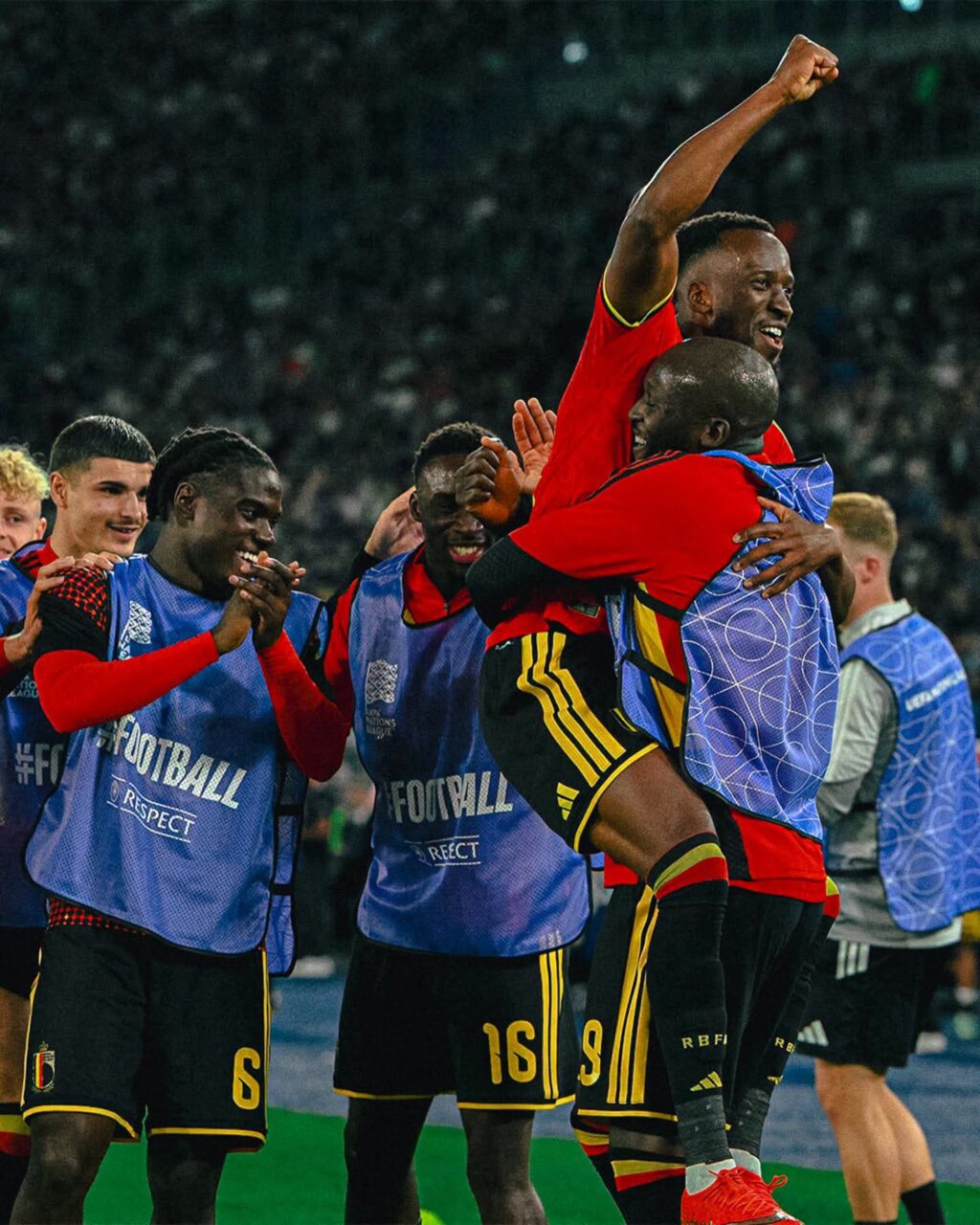
And the celebration that followed told its own story.
His Belgian teammates rushed towards him.
Players from the bench joined the celebrations.
Lukébakio raised his fist while teammates surrounded him.
The picture shared by Benfica captured the emotion perfectly: a group of Belgian players celebrating together after a goal that had given their country a commanding advantage in Rome.
It was not just a goal.
It was a statement.
WHY LUKÉBAKIO’S GOAL MATTERED SO MUCH
The timing of Lukébakio’s goal was almost as important as its quality.
Italy had started the second half with real intensity.
They were pushing Belgium back.
They had opportunities.
They were beginning to believe an equaliser was possible.
Then, in one attack, Belgium turned the entire situation around.
That is what makes counter-attacking football so dangerous.
A team can dominate possession and still be vulnerable if it loses the ball in the wrong area.
Lukébakio’s goal demonstrated exactly that.
He did not need several passes.
He did not need a long period of possession.
He needed one opportunity.
He received the ball.
He attacked space.
He cut inside.
He shot.
Goal.
For Belgium, it was ruthless.
For Italy, it was devastating.
And for Lukébakio personally, it was a moment that could become one of the defining highlights of Belgium’s Nations League campaign.
DONNARUMMA COULD DO NOTHING
Italy’s goalkeeper Gianluigi Donnarumma had already done plenty to keep his team in the match.
He had denied De Ketelaere.
He had stopped Raskin.
He had prevented Godts from scoring again.
He had made several important interventions during Belgium’s strong first half.
But when Lukébakio unleashed his shot, there was little he could do.
The strike was too powerful and too well placed.
The goal was not the result of a goalkeeper making a mistake.
It was individual quality.
Lukébakio created the opportunity himself and finished it himself.
That distinction is important.
Belgium’s second goal came at the exact moment they needed someone to produce something special.
Lukébakio did.
BELGIUM’S DEFENCE THEN COMPLETES THE JOB
After the second goal, Italy needed something extraordinary.
They had already been frustrated by Belgium’s goalkeeper.
Now they were two goals behind.
The hosts continued looking for a way back.
Riccardo Calafiori came close with a left-footed effort that went just wide.
Later, Giorgio Scalvini hit the crossbar.
Italy had chances.
But the goal never came.
Belgium’s defensive organisation held.
Lammens remained reliable.
And the final whistle eventually confirmed what had seemed increasingly likely after Lukébakio’s goal.
Italy 0.
Belgium 2.
A perfect opening result for Van Bommel.
SENNE LAMMENS DESERVES HIS OWN HEADLINE
Although Lukébakio’s goal was the moment that attracted the headlines, Belgium’s victory was not achieved by the attackers alone.
Senne Lammens played a major role.
The Belgian goalkeeper was tested repeatedly, particularly after halftime when Italy increased the pressure.
According to SofaScore’s match data, Lammens made six saves and received an 8.8 rating, with several of his interventions coming from inside the penalty area.
That statistic helps explain how Belgium managed to keep a clean sheet despite Italy’s second-half pressure.
A football team needs more than goals to win major matches.
It needs players who can perform when the game becomes uncomfortable.
Lammens did exactly that.
His saves allowed Belgium to remain ahead long enough for Lukébakio to deliver the decisive second goal.
Without those saves, the match might have looked completely different.
VAN BOMMEL’S DREAM START
For Mark van Bommel, this was almost the perfect way to begin his time as Belgium coach.
A difficult away match.
A strong opponent.
A clean sheet.
Two goals.
A positive attacking performance.
And a victory in Rome.
The former Netherlands midfielder has now begun his Belgium tenure with a result that immediately creates optimism around his new project.
The most interesting part is that Belgium did not win through one single method.
They showed different sides of their game.
They attacked early.
They created chances.
They defended when Italy pushed.
They relied on their goalkeeper.
They counter-attacked.
And they eventually killed the match with a moment of individual brilliance.
Goal.com described Van Bommel’s first match as Belgium coach as a convincing win, highlighting the new attacking setup that included Godts and Moreira on the flanks and De Ketelaere through the middle.
That is important because international football offers managers very little training time.
Club coaches can work with their players every day.
National-team coaches cannot.
They have to communicate ideas quickly.
They have to build chemistry quickly.
And they have to find results quickly.
Van Bommel’s first competitive test could hardly have been more demanding.
Yet Belgium passed it.
THE BENFICA CONNECTION: LUKÉBAKIO’S MOMENT
For Benfica supporters, Lukébakio’s performance adds another reason to celebrate.
The Belgian forward is a Benfica player, and his international goal provides another highlight for supporters following his career at club and country level.
The photograph shared by Sport Lisboa e Benfica showed Lukébakio celebrating with his Belgium teammates after the victory.
The image captures something football fans understand immediately.
A player can score for his country, but the emotion belongs to an entire team.
Lukébakio’s celebration was not isolated.
His teammates surrounded him.
The bench celebrated.
The Belgian players were clearly aware of the importance of the goal.
For Benfica, the goal also offers supporters a glimpse of what Lukébakio can bring when he is given space to attack.
Speed.
Directness.
Confidence.
And the willingness to shoot.
Those characteristics were all visible in Rome.
A GOAL THAT SHOWED LUKÉBAKIO’S PERSONALITY
There are different types of goals.
Some are created through complicated passing sequences.
Some come from set pieces.
Some are tap-ins.
Some come from defensive mistakes.
And some goals are simply about one player deciding that he is going to take responsibility.
Lukébakio’s goal belonged to the final category.
He received the ball.
He moved forward.
He carried the attack.
He cut inside.
And he took the shot.
That confidence is important for an attacking player.
There was another option available.
He could have passed.
He could have waited.
He could have slowed the attack down.
Instead, he saw the opportunity and attacked it.
That is exactly the kind of decision that can change football matches.
GODTS AND LUKÉBAKIO: TWO DIFFERENT GOALS, ONE BIG RESULT
Belgium’s two goals also told two different stories.
Godts’ goal was about movement, technique and composure.
Lukébakio’s goal was about power, direct running and individual confidence.
Together, they demonstrated the variety available in Belgium’s attack.
Godts opened the scoring in the 20th minute.
Lukébakio finished the match in the 69th.
One goal came from a player who started the game.
The other came from a substitute.
That is another encouraging sign for Belgium.
It means the team has attacking options capable of changing the game from the start and from the bench.
And this could become particularly important during a long international campaign.
KEVIN DE BRUYNE’S ROLE
Even though De Bruyne did not remain on the pitch until the final whistle, his influence was still visible.
He helped create the opening goal, with reports describing his through ball as the pass that allowed Godts to attack the Italian defence before scoring.
At 35, De Bruyne remains an important figure for Belgium.
Reuters reported before the match that the midfielder had said he remained committed to international football while he continued to feel motivated and physically fit. He also spoke positively about working under Van Bommel.
That makes his continued involvement significant for a Belgium team going through a period of transition.
The country is moving beyond the famous generation that included several of the players who helped establish Belgium as a major international force.
But De Bruyne remains.
And his experience can help younger players such as Godts and others adjust to international football at the highest level.
BELGIUM’S GOLDEN GENERATION IS CHANGING
For years, Belgium’s national team was associated with an exceptional generation.
Eden Hazard.
Kevin De Bruyne.
Romelu Lukaku.
Thibaut Courtois.
Vincent Kompany.
Jan Vertonghen.
Toby Alderweireld.
The names changed over time, but the expectation remained the same.
Belgium were expected to compete with the best.
Now the national team is entering another stage.
Some veterans have retired.
Others have stepped away.
Younger players are taking larger roles.
De Bruyne remains one of the most experienced players available, but Belgium’s future will increasingly depend on the emergence of a new generation.
That makes performances like Godts’ particularly interesting.
A young Belgian scoring his first senior international goal in a major Nations League match against Italy is the kind of moment that can become important in a team’s development.
And Lukébakio’s contribution shows that Belgium also have experienced attacking players capable of providing decisive moments.
ITALY’S NIGHT TO FORGET
For Italy, the result was extremely disappointing.
The Azzurri had entered the match hoping to start a new chapter positively.
Instead, they lost 2–0 at home.
Mancini’s return to the Italy bench therefore began with defeat.
The Italian side also had to deal with the psychological damage of conceding first and then failing to take advantage of their second-half opportunities.
The result was especially frustrating because Italy did create chances.
They were not completely dominated for the entire 90 minutes.
After halftime, they pushed Belgium.
Kean had a major opportunity.
Pio Esposito tested Lammens.
Calafiori went close.
Scalvini hit the crossbar.
But none of those chances became goals.
That is the cruel side of football.
A team can create opportunities and still lose comfortably on the scoreboard.
MANCINI’S RETURN DOES NOT GO TO PLAN
Roberto Mancini returned to the Italy job with enormous expectations.
He had previously led Italy to European Championship glory in 2021, but his return came at a difficult moment for the national team.
Reuters reported before the match that Mancini had called for a decisive break from the past and had made major changes to his squad, including nine first-time call-ups, as Italy looked to rebuild.
The Belgium match therefore represented the first major examination of that approach.
The result was not what Mancini wanted.
Italy lost.
But the rebuilding process does not end after one match.
The challenge for Mancini will now be to analyse what went wrong, identify the positives and make adjustments before the next fixture.
Italy players themselves stressed the importance of patience after the defeat.
Giovanni Di Lorenzo said that immediately tearing the national team apart again would not be helpful, while other players pointed to positive periods during the match.
That means the Italian story is not finished.
It has simply begun with a setback.
THE DIFFERENCE BETWEEN THE TWO TEAMS
One of the clearest differences in the match was efficiency.
Belgium created chances and scored.
Italy created chances but failed to score.
That sounds simple, but at international level it can decide everything.
Belgium’s goalkeeper made the important saves.
Italy’s goalkeeper made important saves too.
But Belgium eventually found the decisive moments.
Godts took his opportunity.
Lukébakio took his opportunity.
Italy did not.
That is why the final score read 2–0.
BELGIUM’S COUNTER-ATTACKING THREAT
Lukébakio’s goal also demonstrated why Belgium can be dangerous when opponents commit players forward.
Italy were trying to equalise.
That naturally created space behind them.
Lukébakio exploited it.
His ability to carry the ball over distance gave Belgium an outlet when they were under pressure.
This is particularly valuable because a team defending a lead can sometimes become trapped.
If the defending side cannot escape its own half, pressure keeps returning.
But a player who can take the ball forward changes the equation.
Lukébakio gave Belgium that escape route.
And then he turned it into a goal.
THE IMPORTANCE OF SUBSTITUTES
Modern football is increasingly about the players who enter the game after the first hour.
Starting players may establish the rhythm.
Substitutes can change it.
Lukébakio is the perfect example.
He entered with Italy pressing.
Eleven minutes later, according to Flashscore’s report, he had scored Belgium’s second goal.
That is the definition of an effective substitution.
Van Bommel needed a player who could inject energy.
Lukébakio did more than that.
He changed the scoreline.
THE NIGHT BELONGED TO BELGIUM
When the final whistle arrived, the Belgian players had every reason to celebrate.
They had gone to Rome.
They had faced Italy.
They had played under a new manager.
They had defended a lead.
They had survived pressure.
And they had scored a spectacular second goal.
The 2–0 result also ended Belgium’s long wait for a competitive victory over Italy. Reports noted that this was Belgium’s first competitive win against Italy in six meetings between the countries.
That gives the result additional historical significance.
It was not just another Nations League fixture.
Belgium had finally overcome a difficult opponent in a competitive meeting.
And they did it away from home.
WHAT THIS RESULT MEANS FOR BELGIUM
It is still too early to make sweeping conclusions from one match.
But there are several clear positives.
First, Van Bommel has started with a win.
Second, Belgium scored twice.
Third, they kept a clean sheet.
Fourth, young attacker Mika Godts scored his first senior international goal.
Fifth, Lukébakio showed that he can have a major impact from the bench.
Sixth, Lammens demonstrated that Belgium have a goalkeeper capable of handling pressure.
And finally, the team showed that it can adapt when the opponent changes the rhythm of the game.
Those are valuable signs.
The real test will be whether Belgium can reproduce them in the matches that follow.
WHAT BELGIUM MUST IMPROVE
A 2–0 victory does not mean everything was perfect.
Belgium had periods where Italy created dangerous chances.
The second half in particular demonstrated that the Belgian defence could be placed under serious pressure.
If Belgium face an opponent that is more clinical, giving away those opportunities could be costly.
Van Bommel will therefore have plenty to analyse.
The team needs to improve its ability to control matches after taking the lead.
It needs to prevent opponents from building momentum.
And it needs to remain dangerous when defending.
The encouraging part is that Belgium have already shown they can survive those moments.
LUKÉBAKIO’S NIGHT WILL BE REMEMBERED
Years from now, people may not remember every minute of this Nations League match.
They may not remember every pass.
They may not remember every tackle.
But they are likely to remember Lukébakio’s goal.
That is the power of a spectacular football moment.
One run.
One cut inside.
One strike.
One celebration.
And suddenly a difficult away match becomes a memorable night.
The Benfica forward did not need 90 minutes to leave his mark.
He needed only a few touches.
THE IMAGE THAT TELLS THE STORY
The photograph shared by Sport Lisboa e Benfica captures the emotion better than words can.
Lukébakio is surrounded by his Belgium teammates.
One player embraces him.
Another celebrates nearby.
The substitutes and squad members are visibly excited.
Lukébakio raises his arm in celebration.
The players are not simply celebrating a goal.
They are celebrating what the goal means.
It gave Belgium breathing room.
It punished Italy’s best period of the second half.
And it allowed the team to begin the Van Bommel era with a major away victory.
That is why the photograph is more than a simple celebration image.
It represents the beginning of a new chapter.
FROM BENFICA TO BELGIUM
Lukébakio’s performance also gives Benfica supporters something to talk about.
Players often return from international duty with increased confidence when they have performed well.
Scoring an important international goal against Italy is certainly the kind of experience that can strengthen a player’s confidence.
For Lukébakio, the timing is particularly interesting.
He has now shown that he can make an impact against a major European national team.
The goal also demonstrates that his value is not limited to one specific tactical situation.
He can run at defenders.
He can carry the ball.
He can shoot from distance.
And he can provide energy when entering the game as a substitute.
Those qualities can be useful at club level as well.
BELGIUM’S YOUNG PLAYERS ARE STEPPING FORWARD
Godts and Lukébakio represent different stages of a player’s career, but their performances also demonstrate Belgium’s changing squad.
Godts represents the younger generation.
Lukébakio is already an established international.
De Bruyne provides experience.
Van Bommel provides a new coaching voice.
Lammens provides another important piece in goal.
Together, these elements could help Belgium transition away from the previous generation without completely losing its competitive identity.
That transition will not happen overnight.
International football is unpredictable.
But the ingredients are there.
A MATCH THAT COULD SET THE TONE
The opening match of a competition can sometimes establish the emotional tone for everything that follows.
Belgium could have started this Nations League campaign nervously.
They could have struggled under a new coach.
They could have allowed Italy to dominate.
Instead, they won 2–0.
That does not guarantee future success.
But it provides confidence.
Players now know that Van Bommel’s ideas can work against a major opponent.
The manager now has evidence of what his players can do in a competitive environment.
And supporters have a positive result to build upon.
THE ROAD AHEAD
Belgium’s next matches will provide a much clearer picture of where this team is heading.
According to the current Nations League schedule, Belgium are due to face France shortly after the Italy match, followed by meetings with Türkiye and further fixtures later in the group phase.
The level of opposition means Belgium cannot afford to become comfortable after one victory.
The Italy result is a beginning.
Nothing more.
But it is an extremely significant beginning.
THE BIG QUESTION FOR VAN BOMMEL
The biggest question now is simple:
Can Belgium turn this performance into a pattern?
One excellent match can happen.
A strong tournament requires consistency.
Van Bommel will have to find the right balance between experienced players and younger talent.
He will also have to decide when players such as Lukébakio should start and when they can be more effective as substitutes.
The Italy match provided evidence that the bench can make a difference.
It also showed that Belgium can compete even when their first-choice attacking structure changes during the game.
Those are useful lessons for the new coach.
LUKÉBAKIO HAS GIVEN BELGIUM ANOTHER ATTACKING OPTION
The most obvious individual takeaway is that Lukébakio has strengthened Belgium’s attacking options.
His goal was not a lucky deflection.
It was a deliberate piece of individual quality.
He received the ball.
He drove forward.
He created space.
He shot.
That ability to create something independently is valuable.
International matches are often tight.
There may be few opportunities.
When those opportunities arrive, players who can manufacture chances themselves become extremely important.
Lukébakio showed that he can be that player.
WHY THE GOAL COULD BECOME A DEFINING MOMENT
Every international campaign has moments that supporters remember.
Sometimes it is a last-minute winner.
Sometimes it is a goalkeeper’s save.
Sometimes it is a young player’s breakthrough.
And sometimes it is a stunning individual goal.
Lukébakio’s strike has the ingredients of one of those memorable moments.
It came against Italy.
It came away from home.
It came during a difficult period of the match.
And it effectively secured the victory.
That combination makes the goal special.
ITALY WILL HAVE TO RESPOND
For Mancini and Italy, the response will be just as important as the defeat.
The Azzurri cannot change the result in Rome.
But they can change what happens next.
Italy’s players have already spoken about the need to take positives from the match.
Calafiori pointed to periods in which Italy played well, while Cambiaghi acknowledged that the team struggled during the first half but expressed confidence about improvement in the next match.
That response will be closely watched.
A rebuilding project is rarely linear.
There will be setbacks.
The question is how quickly a team learns from them.
BELGIUM’S CLEAN SHEET IS JUST AS IMPORTANT AS THE TWO GOALS
It is easy to focus on Lukébakio and Godts because goals create headlines.
But Belgium’s clean sheet may be equally important.
Scoring two goals is valuable.
Preventing the opponent from scoring is equally necessary.
Italy had opportunities.
Belgium’s defence and goalkeeper handled them.
That gives Van Bommel a foundation.
If Belgium can combine defensive reliability with the attacking talent displayed in Rome, they could become a difficult team to play against.
Again, one match is not enough to prove that.
But it is an encouraging starting point.
THE NIGHT BELGIUM FINALLY GOT OVER THE LINE
Belgium have faced Italy several times in recent international history.
There have been difficult matches.
There have been disappointing results.
There have been moments when Belgium created chances but could not win.
This time was different.
Belgium scored first.
They defended their lead.
Italy pushed.
Belgium survived.
Then Lukébakio struck.
That sequence is what makes the result particularly satisfying for the Belgian side.
They did not simply dominate a weak opponent.
They defeated Italy in a competitive match in Rome.
A NIGHT OF FIRSTS
There were several firsts connected to this match.
It was Van Bommel’s first match as Belgium coach.
It was Godts’ first senior international goal.
It was a significant moment for Lammens in goal.
And it was Lukébakio’s decisive contribution from the bench.
That makes the match particularly symbolic.
A new manager.
A new generation.
Experienced leaders.
And a new campaign.
All coming together in one night.
THE FINAL WHISTLE
When the referee finally ended the match, the scoreboard told the whole story.
Italy 0.
Belgium 2.
Godts had opened the scoring.
Lukébakio had finished the job.
Lammens had protected the lead.
Van Bommel had won his first match.
And Belgium had walked away from Rome with three points.
The players celebrated together.
For Belgium, it was a night of confidence.
For Italy, it was a night of frustration.
For Lukébakio, it was a night that belonged to him.
CONCLUSION: DODI LUKÉBAKIO HAS ARRIVED WITH A MESSAGE
Football matches can sometimes be decided by tiny moments.
A goalkeeper makes a save.
A defender loses concentration.
A striker finds half a yard.
An attacker decides to shoot instead of pass.
In Rome, Belgium had several of those moments.
Mika Godts provided the first.
Senne Lammens protected the advantage.
And Dodi Lukébakio delivered the decisive blow.
His goal was the highlight of Belgium’s 2–0 victory over Italy, but the bigger story is the beginning of a new Belgian era under Mark van Bommel.
Belgium did not simply win.
They showed resilience.
They showed attacking quality.
They showed defensive discipline.
They showed that their younger players can step forward.
And they showed that experienced players can still make decisive contributions.
For Lukébakio, however, the night will be remembered for one particular moment.
The ball arrived near halfway.
He drove forward.
He cut inside.
He looked up.
He struck.
The net moved.
Belgium celebrated.
Italy fell further behind.
And a new chapter of Belgian football began with a moment of brilliance.
Dodi Lukébakio did not need many minutes to change the game. He needed only one opportunity — and he took it.
That is what separates good international players from match-winners.
And on a night when Belgium needed a match-winner in Rome, Lukébakio answered the call.
The final score was 2–0.
The first goal belonged to Godts.
The clean sheet belonged to Lammens and Belgium’s defence.
But the image that will dominate the headlines belongs to Dodi Lukébakio — celebrating with his Belgian teammates after producing the strike that silenced the Olimpico.
Belgium have started a new era. And Lukébakio has made sure the world noticed.