Laurențiu Reghecampf is officially back at FCSB.
The announcement may have been short, but the significance of the move is anything but small.
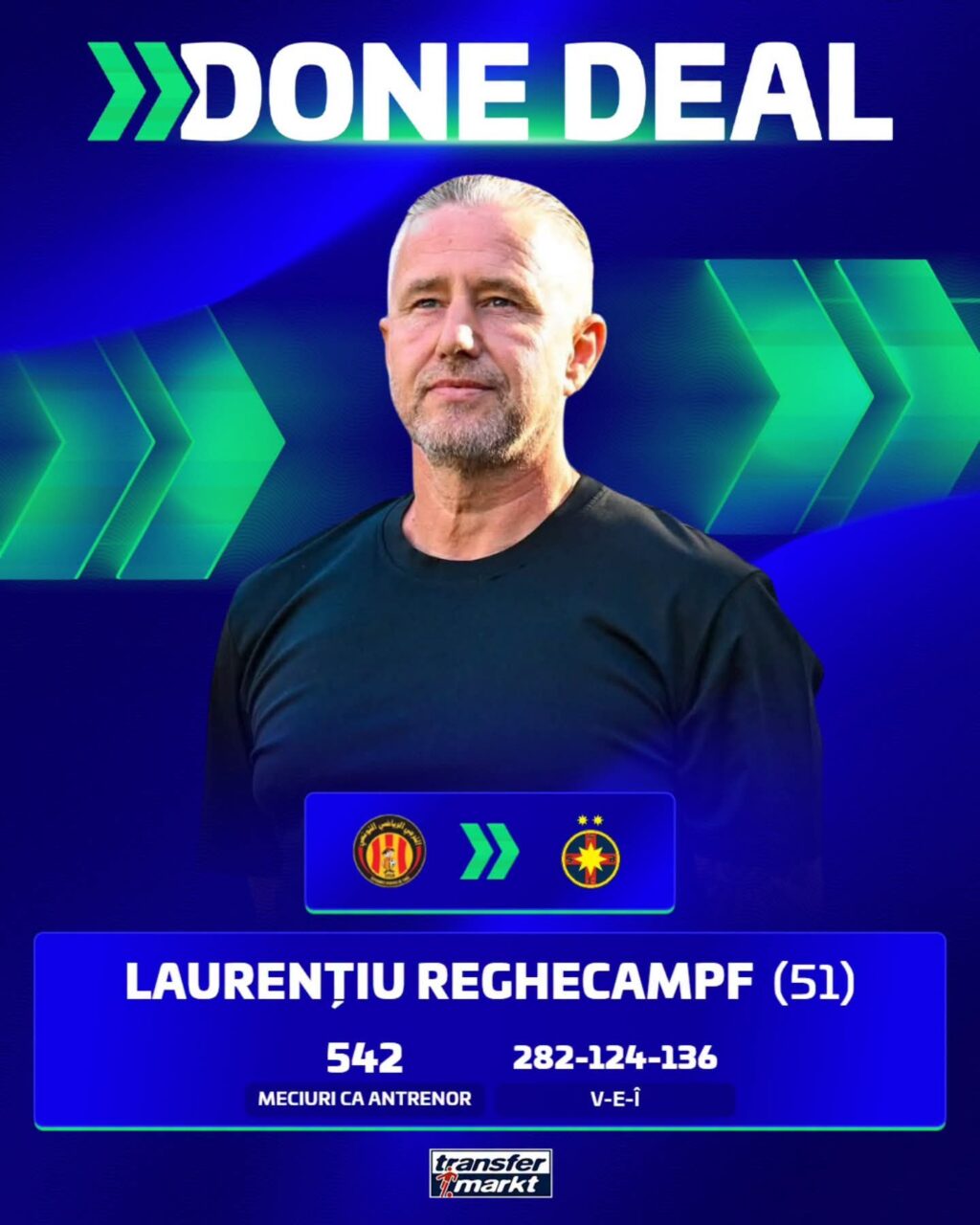
Transfermarkt.ro has now highlighted the return with a “DONE DEAL” graphic showing Reghecampf moving back to FCSB, accompanied by his career record of 542 matches as a coach, 282 victories, 124 draws and 136 defeats. Current manager data also lists him as FCSB’s coach following his September 2026 appointment.
For FCSB supporters, however, the most important number is not 542.
It is three.
This is Reghecampf’s third spell in charge of FCSB.
The return comes at a difficult moment for the Bucharest club. FCSB entered the 2026/27 SuperLiga campaign with expectations of competing near the top, but after 10 rounds they were sitting 11th with only 12 points from three wins, three draws and four defeats. The situation became even more serious after a devastating 5-0 defeat away to Universitatea Craiova.
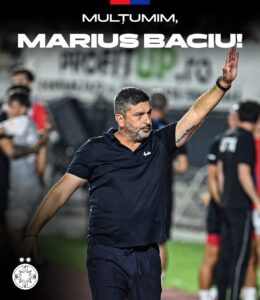
That result was followed by the departure of Marius Baciu.
And within days, a familiar name was back at the club.
Laurențiu Reghecampf.
The coach who previously delivered league titles.
The coach who led FCSB into major European nights.
The coach who already understands the pressure surrounding the club.
Now he has returned to try to change the direction of a season that has started badly.
And there is one immediate target waiting for him.
Oțelul Galați.
FCSB’s first match under Reghecampf’s third spell is scheduled for October 10, giving the returning coach a short period to prepare his team before the new era officially begins on the pitch.
The announcement is official.
The “DONE DEAL” graphic is already circulating.
But now comes the difficult part.
Can Reghecampf bring FCSB back to where the club believes it belongs?
The “DONE DEAL” announcement that has FCSB fans talking
Transfermarkt.ro’s post captured the story in the simplest possible way.
A large “DONE DEAL” headline.
A picture of Laurențiu Reghecampf.
The FCSB crest.
And the coach’s career numbers.
The graphic identifies Reghecampf as a 51-year-old manager and displays 542 matches, 282 wins, 124 draws and 136 defeats. Those figures correspond with current manager statistics available for Reghecampf’s career.
The message accompanying the post is equally direct:
“Laurențiu Reghecampf returns to the technical leadership of FCSB.”
There is no ambiguity.
This is not a rumour.
This is not another name being discussed as a possible replacement.
Reghecampf is back.
FCSB officially presented him on September 24, and the appointment represents his third period as head coach of the Bucharest club.
The move immediately created interest because of the coach’s history.
Reghecampf is not walking into FCSB for the first time.
He already knows the club.
He already knows the pressure.
He already knows what it means to work under enormous expectations.
And he already knows what it feels like to win trophies in the red and blue colours.
That history is one of the biggest reasons his return is attracting so much attention.
Why FCSB turned to Reghecampf again
The timing explains almost everything.
FCSB’s league campaign had become increasingly difficult before the coaching change.
After 10 matches, the club had accumulated just 12 points.
Three victories.
Three draws.
Four defeats.
That left them in 11th position.
Then came the match against Universitatea Craiova.
FCSB lost 5-0.
The result was heavy enough to force another major decision.
The club announced the termination of Marius Baciu’s contract and the contracts of his assistants Sorin Bucuroaia and Alexandru Ioniță.
The next question was obvious.
Who would replace him?
The answer came quickly.
Reghecampf.
It was a familiar solution to a serious problem.
Rather than appointing a coach with no previous connection to the club, FCSB opted for somebody who had already experienced both the pressure and the success of the job.
It was a move designed to bring immediate authority into the dressing room.
And there is another important factor.
Reghecampf was available after ending his contract with Esperance Sportive de Tunis. Digi Sport reported that he terminated his agreement with the Tunisian club before returning to FCSB.
So the opportunity appeared at exactly the right moment.
For FCSB, it was a chance to bring back a coach they already knew.
For Reghecampf, it was a chance to return to one of the most important clubs of his career.
This is Reghecampf’s third FCSB chapter
There is something unusual about this appointment.
It is not simply the return of a former coach.
It is the beginning of a third chapter.
Reghecampf’s first FCSB spell ran from 2012 to 2014.
His second came between 2015 and 2017.
Now, after years away, he is back again in 2026.
That means there are already two previous eras against which this one will inevitably be compared.
The first was filled with major success.
The second brought more trophies and European football.
The third begins with FCSB sitting 11th.
That contrast makes the story particularly interesting.
Reghecampf is not returning to a team that is already dominating the league.
He is returning to a club that needs rebuilding.
He has to restore confidence.
He has to improve results.
He has to organise the defence.
He has to make the attack more effective.
And eventually, he has to close the gap to the teams above FCSB.
That is a considerably different challenge from the one he faced during his first appointment.
Reghecampf’s first FCSB spell created the legend
To understand why his return has generated such a strong reaction, you have to go back to 2012.
That was when Reghecampf first took charge of FCSB.
According to Romanian reports, he managed the club for 103 matches during his first period, recording 63 wins, 27 draws and 13 defeats. He also won two consecutive league championships.
But the trophies tell only part of the story.
That FCSB side became one of the most recognisable Romanian teams of its generation.
The club played with intensity.
The team developed a strong physical identity.
The players appeared to understand their roles.
And FCSB became a serious European opponent.
For supporters, those years remain a reference point.
That is why Reghecampf’s return is about more than simply changing the coach.
It brings back memories of a period when FCSB were competing at the top of Romanian football.
Two league titles remain the biggest part of his FCSB legacy
Reghecampf’s greatest achievement at FCSB remains the two league titles he won during his first spell.
Those championships established his name in the club’s modern history.
He was no longer simply a young Romanian coach with potential.
He had become a coach who could build a championship-winning team.
That history matters now because FCSB are again looking for somebody who can compete for trophies.
The club’s ambitions have not disappeared.
Reghecampf himself has acknowledged that.
During his presentation, he said the ambitions at FCSB remain focused on victories and trophies.
So although the immediate problem is the league table, the long-term expectations remain much bigger.
FCSB want to compete.
They want trophies.
And they want European football.
Reghecampf knows that better than most coaches who could have taken the job.
The European nights are another reason for the excitement
Reghecampf’s first spell was not only about domestic success.
FCSB also enjoyed memorable European campaigns.
In the 2012/13 Europa League, the club reached the knockout stages.
One of the most famous moments came against Ajax.
FCSB lost the first leg 2-0 in Amsterdam.
Then came the response in Bucharest.
FCSB won 2-0 and progressed on penalties.
The next opponent was Chelsea.
FCSB won the first leg 1-0 at home before Chelsea won 3-1 in London to advance.
Those matches became part of the club’s European identity.
The following season, FCSB also reached the Champions League group stage under Reghecampf.
That is important because the returning coach has already spoken about wanting to take FCSB back toward that level.
The Champions League remains one of his ambitions.
But before that dream can become realistic, FCSB have to solve their domestic problems.
Reghecampf’s second spell brought more silverware
The coach returned to FCSB in December 2015.
That second period was different from the first.
FCSB did not dominate the league in the same way.
But Reghecampf still won trophies.
He helped FCSB win the League Cup and Romanian Super Cup during that period.
He also guided the club into the Europa League group stage.
According to Romanian reports, his second spell consisted of 73 matches, with 37 wins, 20 draws and 16 defeats.
That means Reghecampf’s overall FCSB history contains a substantial amount of experience.
He knows how to work under the club’s demands.
He knows the environment.
He knows the expectations.
And he knows the personalities involved.
That familiarity could be important during a season that already needs a significant turnaround.
Now he returns after a brutal 5-0 defeat
The circumstances of his third appointment could not be more different.
The previous coach did not leave after a narrow defeat.
He left after FCSB were beaten 5-0 by Universitatea Craiova.
The scoreline was a major blow.
And it came after a series of inconsistent results.
FCSB had already lost to CFR Cluj, UTA Arad and Dinamo București during the opening 10 rounds.
The team had also drawn matches they would have expected to win.
So the problem was not simply one bad afternoon.
The Craiova defeat became the final trigger.
It exposed the extent of the team’s problems.
And it created the opening for Reghecampf.
The new coach knows exactly what he has to fix
Reghecampf did not pretend that the situation was perfect during his first press conference.
Instead, he acknowledged the amount of work ahead.
He said the most important immediate objective was winning the first match and helping the players regain confidence and desire to play.
That statement is revealing.
He understands that tactical changes alone will not solve everything.
The players also need to believe again.
A team that has just lost 5-0 can carry that result into its next match.
Every mistake can remind players of the previous defeat.
Every missed chance can create frustration.
Every goal conceded can create fear.
Reghecampf’s job is to break that cycle.
Confidence could be the first major battle
Football teams are heavily influenced by confidence.
A confident side takes risks.
A struggling side can become cautious.
That difference can completely change a match.
Reghecampf therefore needs to rebuild the mental side of the team.
He has already said that restoring the players’ confidence is one of his immediate priorities.
That may be just as important as changing the formation.
If the players believe they can win, their decisions become faster.
If they are afraid of another mistake, they may hesitate.
The new coach needs to create an environment where players are willing to take responsibility again.
The first match has already been confirmed
The first competitive match of Reghecampf’s third FCSB spell will be against Oțelul Galați.
It is scheduled for October 10, 2026, at the National Arena. Digi Sport reports the match is scheduled for 21:30 local time, while its match programme confirms it as the first game of Reghecampf’s new mandate.
That gives the coach approximately 16 days between his presentation and his first official match.
Those 16 days could be extremely important.
He has time to train.
He has time to assess his players.
He has time to study the opposition.
He has time to work on defensive organisation.
He has time to introduce his tactical ideas.
And perhaps most importantly, he has time to communicate with the dressing room.
Oțelul will provide the first real test
The first match will not determine the entire season.
But it will establish the tone.
If FCSB perform well, supporters will immediately have something positive to build on.
If the team wins, Reghecampf will have the perfect beginning to his comeback.
If the performance is poor, the questions will start again.
That is why the Oțelul game is already attracting attention.
It is not just another league fixture.
It is the first chapter of the third Reghecampf era.
FCSB’s players now have a fresh opportunity
A coaching change can completely alter the situation for players.
Someone who was previously on the bench may become a starter.
A player who was struggling for form may receive another chance.
A young player may suddenly become more important.
An experienced player may be asked to take more responsibility.
Everyone starts with a new opportunity.
Reghecampf has already expressed confidence in the squad.
Reports from his presentation quoted him saying that he believes the team possesses quality and that the individual level of many players is high.
That means the coach does not appear to believe the squad needs to be completely rebuilt.
Instead, he wants to extract more from the players already there.
The defensive problems will demand immediate attention
The 5-0 defeat naturally puts the defence under the microscope.
Conceding five goals in one match is a serious warning sign.
Reghecampf has spoken about individual mistakes and the need to improve the team collectively.
The coach must therefore decide whether the problem is structural, individual or both.
Does the defensive line need to play deeper?
Does the midfield need to offer more protection?
Does the team need to press differently?
Are players leaving too much space between the lines?
Are individual errors creating unnecessary opportunities?
These are questions the coaching staff will need to answer during the preparation period.
But fixing the defence will not be enough
FCSB also need to score.
A team cannot climb the table by simply trying not to concede.
The club needs wins.
And wins require goals.
That means Reghecampf must also improve the attacking structure.
The midfield needs to create.
The wingers need to provide width.
The forwards need better service.
Set pieces could become important.
And the team needs players capable of deciding close matches.
The ideal version of FCSB under Reghecampf will therefore need both sides of the game.
More organised defensively.
More dangerous offensively.
Thomas Neubert remains part of the setup
One of the familiar names around Reghecampf’s return is Thomas Neubert.
Neubert was part of Reghecampf’s previous successful FCSB era and remains involved in the current technical structure.
The staff for the third spell includes Viorel Dinu as assistant coach and Adrian Popa as fitness coach, alongside Lucian Filip, Alin Stoica, Thomas Neubert, Marius Popa and Ionuț Zottu.
That means there is a mixture of familiarity and change.
Some members understand the club already.
Others are joining Reghecampf for the first time.
The task will be getting everyone working toward the same objectives.
The relationship with Mihai Stoica adds another layer
The Transfermarkt graphic is about Reghecampf.
But the FCSB story also includes Mihai Stoica.
Stoica was involved in presenting the returning coach and spoke positively about their previous experiences together.
The relationship is significant because Stoica has been a central figure around FCSB for years.
He knows the club.
He knows the supporters.
And he knows Reghecampf.
That familiarity can make the transition easier.
But it also means expectations will be high.
Everyone involved remembers what the previous Reghecampf teams achieved.
Reghecampf’s career numbers tell another part of the story
The Transfermarkt graphic displays an impressive overall managerial record.
542 matches.
282 wins.
124 draws.
136 defeats.
That means Reghecampf has won more than half of his managerial matches according to the current career statistics shown on Sofascore.
His current preferred formation is listed as 4-2-3-1.
His career has also taken him far beyond Romania.
He has coached in Saudi Arabia, Qatar, the United Arab Emirates and Tunisia, among other destinations.
Those experiences have added to his coaching background.
But none of those jobs carry quite the same emotional connection as FCSB.
This is a club where his name is already associated with trophies.
His recent spell at Esperance ended before the FCSB return
Reghecampf was coaching Esperance Sportive de Tunis before returning to FCSB.
Digi Sport reported that he ended his contract with the Tunisian club before taking the FCSB job.
That makes the move particularly quick.
One job ended.
Another began.
And the second one was at a club where he already had a history.
For Reghecampf, it was clearly an opportunity he wanted.
He told reporters that he was very happy to return and that the move was something he wanted.
The Champions League remains part of the dream
One of the biggest objectives surrounding the new era is European football.
Reghecampf has already experienced Champions League football with FCSB.
He knows how much the competition can mean financially and sporting-wise for the club.
But the road back is not straightforward.
FCSB first need to improve their domestic position.
After 10 rounds, they are 11th.
They have already lost four matches.
They need to recover points.
And they need to build a consistent run.
Only after that can the bigger European objective become the central focus.
Reghecampf has nevertheless made it clear that he wants FCSB competing for trophies and aiming toward the Champions League again.
Reghecampf’s ambition is already clear
The returning coach did not arrive talking about survival.
He talked about winning.
He talked about trophies.
He talked about confidence.
And he talked about restoring the team’s strength.
His message was that FCSB should once again become a side capable of controlling matches.
That is an ambitious objective.
But it is also consistent with the expectations surrounding the club.
FCSB are not a club that normally settles for simply finishing somewhere in the middle.
The pressure is always toward the top.
There is already talk of a dramatic ten-match target
The atmosphere around Reghecampf’s return has also produced some striking comments.
Digi Sport reported comments from Gigi Becali concerning the coach’s ambitions, including the claim that Reghecampf had spoken about winning a large number of matches and being at the top after 10 rounds.
Those comments should be treated as reported remarks rather than an established future outcome.
The actual league table will determine what happens.
For now, the important point is that expectations around the new coach are already extremely high.
The pressure is not simply to improve.
It is to improve quickly.
The return of Reghecampf also brings back the title conversation
Before the coaching change, the conversation around FCSB was dominated by poor form.
Now the title has returned to the discussion.
That does not mean FCSB are currently leading the league.
They are not.
It means the club is setting a much higher objective for the remainder of the campaign.
Reghecampf has publicly said he wants to win the championship.
Whether that becomes possible will depend entirely on results.
The first task is to close the gap.
The second is to maintain consistency.
The third is to remain competitive when the biggest fixtures arrive.
The next few weeks could define the mood around the club
The international break provides a short pause.
But once league football returns, the pressure will return with it.
The Oțelul match will be the first.
Then come more difficult fixtures.
FCSB will need to show that the coaching change has produced more than an emotional reaction.
They need better performances.
They need points.
They need wins.
And they need to stop the type of defensive collapse that produced the 5-0 defeat at Craiova.
What supporters will be watching against Oțelul
The result will obviously matter.
But supporters will also be looking for signs of change.
Will the team look more organised?
Will the players press with greater intensity?
Will there be more movement in attack?
Will the midfield protect the defence better?
Will the team react positively if it concedes?
Will Reghecampf’s tactical ideas already be visible?
These questions will make the first match fascinating.
One game cannot answer everything.
But it can provide clues.
Reghecampf has already delivered one message to the supporters
During his first days back, the coach also sent a message to the fans.
Digi Sport reported that Reghecampf called on supporters to attend the upcoming match in large numbers and support the team.
That is another sign of what he wants.
He wants the supporters involved.
He wants the National Arena to feel different.
And he knows that the relationship between players and supporters can become extremely important during a recovery.
A team climbing the table needs confidence from inside the dressing room.
It can also benefit from confidence coming from the stands.
The first goal is to make FCSB difficult to beat again
Before thinking about titles, FCSB need stability.
That means reducing mistakes.
It means improving defensive organisation.
It means controlling matches better.
It means turning narrow defeats into draws and draws into victories.
That process may sound simple.
It is not.
But it is the foundation of every successful recovery.
Reghecampf’s previous FCSB teams were known for their competitiveness.
Now he has to recreate that mentality with a completely different squad.
This is not the same FCSB team from 2012
That point cannot be ignored.
The players are different.
The league is different.
The tactical environment is different.
The club itself has changed.
Reghecampf is also a different coach now.
He has accumulated another decade of experience.
So nobody should expect the 2026 version of FCSB to simply copy the 2012 team.
The coach can use lessons from the past.
But he must create a new identity.
That is part of what makes this third spell so interesting.
The coach has a long-term contract target in mind
The appointment is not designed merely as a temporary emergency solution.
The club wants Reghecampf to lead the team forward.
His ambitions go beyond fixing the next match.
He wants trophies.
He wants European competition.
He wants Champions League football.
And he wants FCSB competing at the top again.
That means the coming months will be about much more than one result.
Could the old FCSB spirit return?
That is the question supporters will inevitably ask.
The old Reghecampf teams were associated with intensity, discipline and strong results.
The new team has to develop those characteristics in its own way.
If it does, the comparison will become stronger.
If it does not, supporters will quickly move away from nostalgia and focus on the present.
That is why the first few months are so important.
The pressure on the players is now different
Before Reghecampf arrived, players could perhaps point to the instability around the team.
Now the situation has changed.
The club has made its decision.
The new coach has been presented.
The players know who is in charge.
There are no excuses about uncertainty over the technical leadership.
Everyone knows what the expectations are.
That could produce a reaction.
Players who want to establish themselves must now convince Reghecampf that they deserve to be part of his plans.
Some players could become the surprise winners of the coaching change
This is one of the most interesting things to watch.
A new coach always has preferences.
Reghecampf will have his own ideas about which players fit his system.
A player who was previously overlooked could suddenly become important.
A young player could earn more minutes.
An experienced player could regain a leadership role.
The first training sessions will provide clues.
But the final answer will come through selections and results.
FCSB cannot afford another slow start
The opening 10 rounds have already cost the club valuable points.
Another run of poor results would make the recovery increasingly difficult.
That is why the Oțelul match carries so much importance.
Reghecampf does not need to win the entire championship in October.
He needs to start collecting points.
One win.
Then another.
Then another.
That is how the table changes.
The October schedule will be revealing
FCSB will have several opportunities to demonstrate whether the new era is working.
Oțelul comes first.
Then the team faces other opponents in a league campaign where every point matters.
The club will also have to manage the physical demands of the season.
Reghecampf will need to rotate his squad.
He will need to manage injuries.
He will need to keep players motivated.
And he will need to maintain concentration when the pressure increases.
A third spell means a third chance to create history
Reghecampf has already created a significant legacy at FCSB.
But returning means he now has the opportunity to add another chapter.
If he can take the team from 11th into the title conversation, that would become a significant part of his story.
If he can win another trophy, the comeback would become even more memorable.
If he can return FCSB to the Champions League, the story would gain another major chapter.
Those are objectives, not guaranteed outcomes.
The season will decide whether they become reality.
For now, the “DONE DEAL” is only the beginning
Transfermarkt’s graphic says what supporters already know.
DONE DEAL.
Laurențiu Reghecampf is back.
But a coaching appointment is only the beginning.
The difficult work starts on the training pitch.
The real evidence will come from the matches.
The first opportunity is against Oțelul.
And after that, the season will begin to reveal whether FCSB have genuinely changed direction.
Reghecampf knows the size of the job
The returning coach has already acknowledged that he knows what awaits him.
He knows the pressure.
He knows the expectations.
He knows the club.
And he knows that there is plenty of work to do.
During his presentation, he emphasised that the immediate focus was winning the first match and rebuilding confidence.
That is the right place to begin.
Not with promises of instant success.
Not with excuses.
With the next match.
The FCSB comeback story has all the ingredients
There is already a dramatic storyline.
A big club struggling.
A 5-0 defeat.
A coaching dismissal.
A familiar manager returning.
A third spell.
A history of trophies.
A Champions League ambition.
A new dressing room.
A first match waiting.
And supporters wondering whether the past can somehow become the foundation for a new future.
That is why the Reghecampf appointment has attracted so much attention.
It is more than a coaching change.
It is a return to a club where the manager has already written some of the biggest chapters of his career.
One thing is certain: expectations will be enormous
Nobody will judge Reghecampf simply by whether he can make FCSB slightly better.
The expectations are much higher.
FCSB want trophies.
Reghecampf wants trophies.
The supporters want trophies.
And the club wants to return to European football at the highest possible level.
The coach knows this.
His previous success is precisely why expectations are so high.
The first whistle will change everything
Until October 10, the comeback remains a story.
A headline.
A social-media post.
A Transfermarkt “DONE DEAL” graphic.
A photograph of Reghecampf back at the training ground.
But once FCSB face Oțelul, the conversation changes.
The tactics will be analysed.
The lineup will be discussed.
The performance will be judged.
And the result will become the first piece of evidence in the third Reghecampf era.
That is when nostalgia ends.
Football begins.
Final word
Laurențiu Reghecampf is back at FCSB.
The 51-year-old coach has returned to the Bucharest club for his third spell, after the team endured a difficult opening 10 matches of the 2026/27 SuperLiga season. FCSB entered the international break in 11th place with 12 points, following three wins, three draws and four defeats.
The immediate trigger for the change was the 5-0 defeat against Universitatea Craiova, a result that was followed by the departure of Marius Baciu and his coaching staff.
Reghecampf then arrived.
And the significance of the appointment goes far beyond the current table.
He is a two-time Romanian champion with FCSB.
He has already guided the club through memorable European campaigns.
He has won trophies.
He has experienced the pressure.
And he already knows the people and environment surrounding the club.
Transfermarkt’s new graphic summarises his wider managerial career with 542 matches, 282 victories, 124 draws and 136 defeats, while current manager data confirms his return to FCSB.
But past success cannot win future matches.
Reghecampf now has to build a new team.
He has to restore confidence.
He has to reduce defensive mistakes.
He has to make FCSB more consistent.
And he has to start collecting points.
His first competitive test is already waiting.
FCSB vs Oțelul Galați, October 10, 2026.
That match will mark the beginning of the third Reghecampf era.
For FCSB supporters, it will be a chance to see whether the familiar face can bring something new.
For Reghecampf, it is the start of another attempt to write his name into the club’s history.
And for FCSB, the objective is clear.
The club needs to climb.
It needs to compete.
It needs to win.
And eventually, it wants to fight for trophies and return to the Champions League stage.
“DONE DEAL” has confirmed the return.
Now the pitch has to provide the answer.
**Laurențiu Reghecampf is back at FCSB. The comeback has begun.**
For your FCSB news story