The message from FCSB was short.
“Guess who’s back? ❤️💙”
But the photograph said almost everything.
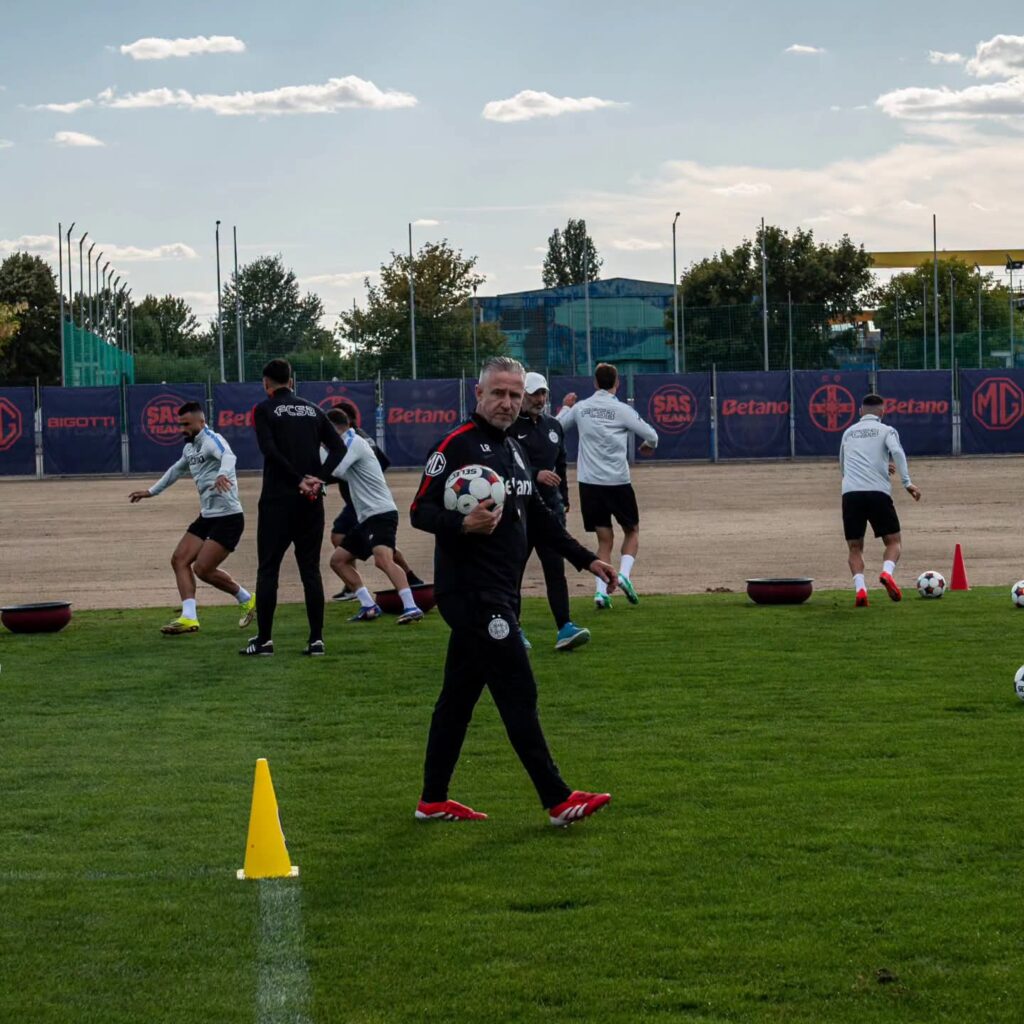
Laurențiu Reghecampf was back inside the FCSB training base, walking alongside Mihai Stoica as players gathered around the club’s returning coach.
After a difficult start to the 2026/27 season, a dramatic coaching change and a humiliating 5-0 defeat to Universitatea Craiova, FCSB have turned to a familiar face.
Reghecampf is back.
And this time, the challenge is enormous.
The Romanian coach has returned to FCSB for a third spell, almost a decade after his previous departure, with the club sitting 11th in the SuperLiga after 10 rounds and desperately needing a change in direction. FCSB had collected just 12 points from their opening 10 league matches, with three wins, three draws and four defeats.
The timing could hardly be more dramatic.
FCSB are not returning to Reghecampf because everything is going perfectly.
They are bringing him back because the situation has become difficult enough for the club to make another major intervention.
And Reghecampf knows exactly what that means.
He has been here before.
He has experienced the pressure.
He has won trophies with the club.
He has led FCSB into European competition.
He knows Mihai Stoica.
He knows the expectations surrounding the club.
And now, at 51, he has been given another opportunity to change the direction of a team that has fallen badly behind where it expected to be.
The first match of his new era is already scheduled.
FCSB will host Oțelul Galați on October 10 in the 11th round of the SuperLiga.
That match will be about much more than three points.
It will be the first real test of the Reghecampf comeback.
And the question on everyone’s mind is simple:
Can the man who previously delivered two league titles to FCSB now revive a team that has lost its way?
FCSB’s “Guess Who’s Back?” post says everything
The FCSB social-media post immediately caught attention because of how little the club needed to say.
There was no long announcement.
No detailed explanation.
No dramatic statement.
Just four words:
“Guess who’s back?”
The image showed Reghecampf walking through the club’s training facilities with Mihai Stoica.
Reghecampf was wearing FCSB training gear.
The club’s crest was visible.
The message was accompanied by the familiar red and blue hearts.
The reaction from supporters was immediate, with thousands of likes and hundreds of interactions visible on the post.
The meaning was obvious.
Laurențiu Reghecampf had returned.
And for FCSB supporters who remember his first spell, the photograph carried considerably more meaning than a normal coaching announcement.
This is not a completely new appointment.
This is a return to a period of the club’s history in which FCSB were winning championships, competing deep into European competitions and building one of the strongest teams in Romanian football.
That history is precisely why the appointment is attracting so much attention.
But it is also why expectations will be high.
Reghecampf is not coming back as an unknown coach.
He is returning with a history at the club.
And that history will follow him from his first training session.
Why FCSB needed another major change
To understand why Reghecampf’s return matters, it is necessary to understand where FCSB were before the appointment.
The club entered the 2026/27 SuperLiga campaign with ambitions of competing near the top.
Instead, the results became increasingly difficult.
FCSB opened the league season with a 2-2 draw against Farul Constanța.
They then drew 0-0 away to Sepsi.
A 3-2 victory over Botoșani offered some encouragement.
But the momentum did not last.
FCSB lost 1-0 at CFR Cluj.
They then lost 1-3 at home to UTA Arad.
Another defeat followed against Dinamo București, who won 2-1.
FCSB drew 2-2 with Petrolul.
And then came the result that changed everything.
Universitatea Craiova 5-0 FCSB.
The official Liga Profesionistă de Fotbal records show that defeat on September 19, with FCSB finishing the opening 10 rounds on 12 points.
It was not simply another defeat.
It was the heaviest result of a run that had already raised serious questions.
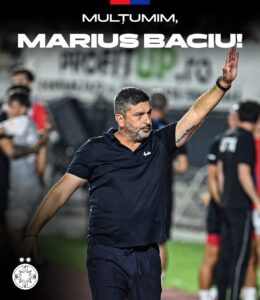
And shortly afterward, FCSB announced the termination of Marius Baciu’s contract and the contracts of members of his staff.
The club needed a new direction.
The answer was somebody who already knew the environment.
Laurențiu Reghecampf.
The 5-0 defeat became the turning point
There are defeats that disappear from memory after a few days.
Then there are defeats that force clubs to change course.
For FCSB, the trip to Craiova became the latter.
A 5-0 defeat leaves little room for interpretation.
The scoreline alone created enormous pressure.
FCSB conceded five goals without scoring.
They left the match with another defeat added to an already poor league record.
And the timing was particularly damaging because the club had already struggled for consistency throughout the opening rounds.
According to the LPF record, FCSB had three victories, three draws and four defeats after 10 matches.
That means the team had taken only 12 of a possible 30 points.
For a club with championship ambitions, that creates a large gap to recover.
The coaching change therefore came at a critical point.
Reghecampf does not have the luxury of spending months simply assessing the squad.
The season is already underway.
Points have already been dropped.
The club’s position in the table is already problematic.
And the supporters want to see a reaction.
Reghecampf is not returning to a team at the top
That is perhaps the most important difference between this appointment and his previous spells.
When Reghecampf first arrived at FCSB in 2012, he inherited a team that was able to become a dominant force under his management.
During his first spell, from 2012 to 2014, he took charge of 103 matches.
His record was 63 victories, 27 draws and 13 defeats.
More importantly, FCSB won two consecutive league titles during that period.
The football also became associated with a high level of physical intensity and tactical organisation.
Thomas Neubert was part of the coaching structure, and the training methods became an important part of the team’s identity.
Now Reghecampf returns under completely different circumstances.
He is not arriving to protect a comfortable lead.
He is arriving to repair a damaged campaign.
That makes the third spell one of the most intriguing chapters of his career at FCSB.
The coach who won two titles is back
Reghecampf’s first FCSB spell remains the strongest part of his connection with the club.
He arrived in 2012.
By the end of that period, he had established himself as one of the most successful coaches in the club’s modern history.
The numbers explain why supporters still remember him.
103 matches.
63 wins.
27 draws.
13 defeats.
And two consecutive league titles.
But the story goes beyond domestic football.
FCSB also enjoyed notable European nights under Reghecampf.
During the 2012/13 Europa League campaign, FCSB reached the round of 16.
One of the most memorable moments came against Ajax.
FCSB lost 2-0 in Amsterdam but won the return leg 2-0 in Bucharest before progressing on penalties.
The club then faced Chelsea.
FCSB won the first leg 1-0 at the National Arena before Chelsea turned the tie around with a 3-1 victory in London.
Those matches helped build the reputation of that FCSB side.
It was competitive.
It was physically strong.
And it was capable of creating major European nights.
Reghecampf was at the centre of that period.
Now he is back.
The second spell was different — but still brought trophies
Reghecampf’s second FCSB spell began in December 2015 following Mirel Rădoi’s departure.
That period lasted until May 2017.
He managed another 73 matches.
His record was 37 wins, 20 draws and 16 defeats.
Although FCSB did not dominate the league in the same way as during his first spell, the team still won trophies.
The club won the League Cup and the Romanian Super Cup during that period.
FCSB also returned to European competition.
In the 2016/17 season, Reghecampf guided the club into the Europa League group stage.
So when FCSB decided to bring him back in 2026, they were not hiring somebody whose only connection to the club was nostalgia.
They were appointing a coach with a documented history of winning trophies there.
That does not guarantee the same outcome this time.
Football does not work that way.
But it explains why the club and its supporters know exactly what they are hoping to see.
Mihai Stoica’s role in the comeback
The photograph in the FCSB post is significant for another reason.
Reghecampf is not walking through the club’s facilities alone.
He is alongside Mihai Stoica.
The relationship between the two men has been a major part of FCSB’s recent history.
And Stoica was the person who formally introduced Reghecampf at the club’s presentation.
According to TVR, Stoica described Reghecampf as a coach with whom he has very positive memories and expressed hope that the club could reproduce the success of his previous two periods.
That is an important detail.
The return is not simply about changing the name on the manager’s office door.
It represents a return to a familiar football structure.
Stoica knows Reghecampf.
Reghecampf knows Stoica.
They know the pressure around FCSB.
They know the expectations of the supporters.
They know the demands coming from the club’s ownership.
And they know that the new era will be judged quickly.
The first objective is not the title
Interestingly, Reghecampf has made it clear that he understands the immediate priority.
It is not simply to talk about winning the championship.
It is to win the next match.
At his presentation, Reghecampf said the most important thing for the staff and supporters was to win the first game and restore the players’ confidence and appetite for football.
That is significant.
The coach understands that FCSB cannot jump from 11th place directly into a championship position.
There has to be a process.
First, results need to improve.
Then confidence needs to return.
Then performances need to become more consistent.
Then the club can think about closing the gap at the top.
Reghecampf himself acknowledged that FCSB are not in a good position and said the team needs to collect points before the winter break.
That is probably the most realistic description of the task ahead.
The comeback starts with one match.
But Reghecampf has already set a much bigger target
The immediate target may be the next game.
The long-term target is much bigger.
Reghecampf has openly said that he wants FCSB to win the championship.
He also wants the club to return to the Champions League.
At his presentation, he explained that the ambitions remain the same: winning trophies and, if possible, returning to the Champions League group stage.
That is an ambitious statement considering the league table.
But it also reflects the expectations of the club.
FCSB do not normally define success as simply avoiding a bad season.
They want trophies.
They want European football.
And they want to compete at the top.
Reghecampf knows that.
He said he wants to transmit to the players that they should become champions.
The message is clear.
The coach is not returning simply to stabilise the team.
He wants to compete.
The Champions League dream is back on the table
One of the most interesting parts of Reghecampf’s presentation was his reference to the Champions League.
He has already experienced that competition with FCSB.
During his first spell, the club reached the Champions League group stage.
Now he wants to take the club there again.
But the road is long.
FCSB first need to recover domestically.
The team are currently 11th after 10 league matches.
There are many points still available, but the deficit created during the opening phase cannot simply be ignored.
The club therefore needs consistency.
It needs to stop losing matches.
It needs to start collecting wins.
And it needs to develop a team capable of competing against the clubs currently above it.
Only then can European qualification become a realistic next step.
Reghecampf has already made his ambition clear.
The work now begins.
The next match will reveal the first changes
The first match of Reghecampf’s third spell is scheduled for October 10.
FCSB will host Oțelul Galați in the 11th round of the SuperLiga.
That gives Reghecampf a short period to work with his players before the game.
It also gives him something extremely valuable:
time to prepare.
He does not have to walk immediately into a match two days after taking the job.
He can work with the squad.
He can assess physical condition.
He can identify tactical problems.
He can speak with individual players.
He can start rebuilding confidence.
And he can decide which players will form the foundation of his team.
The match against Oțelul will therefore be watched closely.
Not only because of the result.
Supporters will want to see whether the team looks different.
Will FCSB press higher?
Will the players look more organised?
Will the defensive mistakes decrease?
Will the midfield become more aggressive?
Will the attackers receive better service?
Those are the questions that will dominate the build-up.
Oțelul are the first obstacle
The first opponent of the Reghecampf era is Oțelul Galați.
LPF’s current record shows Oțelul also entered the season with a mixed record after 10 matches: two victories, four draws and four defeats.
That makes the match particularly interesting.
FCSB cannot afford to treat the game as an automatic victory.
They have already experienced what happens when matches are assumed to be easier than they actually are.
The new manager will want his team to approach the game with concentration.
A strong start would immediately change the mood around the club.
A poor result would create another wave of pressure.
That is the reality of returning to FCSB.
The FCSB players now have something to prove
The arrival of a new manager always creates uncertainty inside a dressing room.
Some players see it as a fresh opportunity.
Others may worry about losing their position.
For Reghecampf, that creates an opportunity to reset expectations.
He has already said that he believes strongly in the quality of the squad.
According to AGERPRES, he said he has great confidence in the majority of the players and believes the individual level of the squad is high for Romanian football.
That is an important message.
He is not arriving and saying that the squad is fundamentally poor.
Instead, he believes the players are capable of performing better.
That puts responsibility back on the players.
If the squad has quality, the next question becomes:
Why has that quality not been visible consistently?
That is one of Reghecampf’s biggest jobs.
Confidence may be the biggest issue
The new coach repeatedly mentioned confidence.
That makes sense after a 5-0 defeat.
Footballers who lose heavily can begin to hesitate.
A defender may become afraid to make an aggressive challenge.
A midfielder may take fewer risks.
An attacker may hesitate before shooting.
A goalkeeper may become nervous after conceding.
One mistake can create another.
The coach’s job is to stop that cycle.
Reghecampf said he wants to restore confidence and bring players back toward the level they demonstrated in previous seasons.
That could become one of the defining themes of his third spell.
He does not necessarily need to rebuild the entire squad.
He may need to rebuild the players’ belief in themselves.
The 5-0 scoreline exposed defensive problems
The Craiova defeat also raises tactical questions.
FCSB conceded five goals.
That means Reghecampf has to examine the entire defensive structure.
Was the back line too exposed?
Was the midfield unable to protect the defence?
Were individual errors responsible?
Was the team too open?
Did the players lose concentration?
Reghecampf himself referred to personal mistakes after the latest defeat and said he believed there were too many individual errors.
That suggests he has already identified at least one area that needs immediate work.
The challenge will be fixing it without sacrificing the team’s attacking qualities.
A team cannot become successful simply by defending deeper.
FCSB also need goals.
They need points.
They need to win.
So Reghecampf must find a balance.
Thomas Neubert’s continued presence is another important detail
One familiar figure remains around the FCSB setup.
Thomas Neubert is still part of the technical staff.
When Reghecampf previously enjoyed his most successful period at FCSB, Neubert was also involved.
That connection has attracted attention because physical preparation became a major feature of the successful FCSB team under Reghecampf.
The current staff includes Neubert alongside Lucian Filip, Alin Stoica, Marius Popa and Ionuț Zottu.
Reghecampf’s new additions include Viorel Dinu as assistant coach and Adrian Popa as fitness coach.
So although the coach is returning, the environment is not exactly the same.
There are familiar faces.
There are new faces.
And there is a new group of players.
The challenge is bringing all of those pieces together.
What about Mihai Pintilii?
Another name naturally enters the conversation whenever Reghecampf returns.
Mihai Pintilii.
The former FCSB midfielder has previously been an important part of the club’s coaching environment.
However, Reghecampf addressed the subject during his presentation.
He explained that when discussions about his return took place, Pintilii was under contract elsewhere and that the situation was therefore not something currently being considered.
That matters because supporters may have expected a complete reunion of familiar figures.
For now, however, Reghecampf has his own staff.
The focus is on the people currently working at the club.
There could also be a major transfer story developing
Another issue that emerged around Reghecampf’s presentation involved Nicolae Stanciu.
The experienced Romanian midfielder has been linked with a possible return to the domestic league.
Digi Sport reported that FCSB are among the clubs interested in Stanciu, alongside Universitatea Cluj, and that his situation could become relevant when his contract in China approaches its end.
Mihai Stoica also discussed the possibility.
But it is important to separate the current facts from speculation.
Stanciu has not been confirmed as a FCSB player.
There is no completed transfer to announce at this point.
What exists is reported interest and discussion around his future.
That distinction matters.
Because once a major coach returns to a big club, transfer rumours naturally increase.
Every available player becomes a potential story.
But Reghecampf’s immediate responsibility is the squad he already has.
The FCSB squad has no shortage of pressure
The players know what the club expects.
FCSB are one of the biggest clubs in Romanian football.
The supporters expect trophies.
The ownership expects results.
The media follows every training session and every selection decision.
And now the coach has returned with a reputation that makes every decision even more visible.
If Reghecampf changes the formation, people will discuss it.
If he drops an experienced player, people will ask why.
If a young player starts, people will ask whether the coach sees something different.
If FCSB win, the comeback narrative will grow.
If they lose, the pressure will increase immediately.
That is the nature of the job.
The “old Reghecampf” comparison will be unavoidable
There will inevitably be comparisons between the Reghecampf of 2012 and the Reghecampf of 2026.
But football has changed.
The players are different.
The tactical environment is different.
The league has changed.
European football has changed.
The coach himself has gained more experience.
So it would be unfair to expect a direct copy of the past.
The new Reghecampf has to build something new.
He can use the lessons from his previous spells.
He can use the relationships he already has.
He can use his knowledge of the club.
But ultimately, this team must develop its own identity.
What made the first Reghecampf era successful?
One of the most frequently discussed aspects of his first spell was organisation.
FCSB became physically demanding.
The team was difficult to play against.
Players understood their responsibilities.
The side could dominate domestic opponents and compete against European teams.
That does not mean the current team will automatically reproduce the same football.
But it provides a blueprint.
Reghecampf knows what he wants from his players.
At his presentation, he talked about wanting the team to regain the strength of a side capable of controlling matches from beginning to end.
That phrase may become important.
Because one of FCSB’s biggest problems recently has been inconsistency.
A team that wants to compete for the championship cannot control one match and disappear in another.
Consistency has to become the foundation.
The road back to the top will not be simple
FCSB have already lost ground.
After 10 rounds, they sit 11th.
There are still many matches remaining.
But every dropped point increases the amount of work required later.
That means Reghecampf cannot afford a slow recovery.
He needs points.
The schedule after the international break will give him several opportunities.
FCSB face Oțelul on October 10.
Then they travel to FC Voluntari on October 17.
They host Rapid București on October 24.
They travel to Universitatea Cluj on October 31.
They then face Corvinul Hunedoara on November 7.
Those fixtures are listed in the LPF schedule.
That run could quickly tell us whether the team is responding to the new coach.
Rapid will be another major test
The derby against Rapid is scheduled for October 24.
That match will inevitably receive major attention.
By then, Reghecampf will have had more time to work with the squad.
Supporters will expect visible progress.
The game will also provide a test of the team’s mentality.
Derby matches require concentration.
They require intensity.
They also bring emotional pressure.
For a new coach, such matches can reveal how quickly his ideas have been absorbed.
But the immediate priority remains Oțelul.
Reghecampf cannot skip steps.
Reghecampf has already spoken about the title race
Despite FCSB’s current position, the returning coach has not abandoned championship ambitions.
He has openly said that he wants to win the league.
He also argued that having several strong teams competing near the top can create opportunities because those teams can take points from each other.
That is his view of the situation.
FCSB are coming from behind.
The job is to collect points and gradually close the gap.
It is not an easy task.
But it is also not impossible to attempt with a large number of matches remaining.
The key will be consistency.
The international break gives Reghecampf valuable preparation time
The timing of his appointment could have been much more difficult.
Instead of immediately playing another league match, FCSB have a period before the October 10 fixture.
That gives the new coaching staff time.
However, international call-ups could reduce the number of first-team players available for some sessions.
Still, Reghecampf can begin implementing his principles.
He can work on positioning.
He can improve fitness.
He can review defensive structure.
He can work on set pieces.
He can communicate expectations.
Most importantly, he can begin understanding his players.
That first period could be critical.
The players who impress Reghecampf could quickly rise
A coaching change often creates opportunities.
Players who were previously on the edge of the starting lineup may suddenly become important.
Young players may receive chances.
Experienced players may regain their places.
The entire squad effectively gets a reset.
Reghecampf has already said that he believes in the squad.
Now players have the chance to prove that his confidence is justified.
The training ground becomes the first competition.
Every session matters.
Every decision matters.
The return is emotional, but the football must come first
The FCSB post is clearly designed to create emotion.
“Guess who’s back?”
The photograph.
The red and blue hearts.
The familiar coach.
The familiar club.
It is an easy story for supporters to connect with.
But once the emotion fades, the football begins.
Reghecampf is not returning simply to recreate memories.
He has been brought back because FCSB need results.
The supporters may celebrate his arrival.
The club may welcome him.
Mihai Stoica may remember the successful years.
But the first league match will judge him on what happens on the pitch.
The biggest challenge may be restoring FCSB’s identity
FCSB have not simply struggled for points.
They have also struggled to produce the kind of consistency associated with a championship contender.
That is what Reghecampf needs to change.
A team needs a clear identity.
Players need to know where they should be.
They need to know what happens after losing possession.
They need to know how to build attacks.
They need to understand how to defend transitions.
They need to know how to respond after conceding.
These details are not created overnight.
But a coach can begin changing them immediately.
Reghecampf’s first press conference sent a clear message
The returning coach did not hide from the challenge.
He said he was happy to be back.
He acknowledged that there was a lot of work to do.
And he emphasised that the immediate priority was to win the first match and restore the confidence of the players.
That message is important.
There was no suggestion that the club would need years to recover.
There was a clear expectation of immediate progress.
That is what supporters will be looking for.
The Champions League target gives the comeback another layer
When Reghecampf speaks about returning FCSB to the Champions League, he is talking about something he has already achieved with the club.
That gives the statement historical context.
He knows the qualification process.
He knows the pressure of European matches.
He knows what it means to take FCSB into the group stage.
But the club must first earn its way there again.
The domestic campaign is the foundation.
If FCSB fail to recover in the league, the European dream becomes more complicated.
So the road to Champions League football begins with the same thing Reghecampf identified as his immediate priority:
winning matches.
Why the FCSB supporters will be watching differently now
The appointment changes the mood.
Before the coaching change, the conversation was largely about what was going wrong.
Now the conversation is about what could happen next.
That does not erase the 5-0 defeat.
It does not erase the dropped points.
It does not change the league table.
But it gives supporters something new to focus on.
A new beginning.
A familiar coach.
A chance to reset.
That is why the FCSB social-media message worked so well.
It captured the emotion of the moment in four words.
Guess who’s back?
Reghecampf has a reputation to protect
A third spell is also significant for the coach himself.
He knows that his previous achievements at FCSB created expectations.
Two league titles in his first spell are a major part of his legacy at the club.
His second spell also brought trophies.
Returning now means those achievements will inevitably be compared with whatever happens next.
If the team succeeds, the comeback will be remembered as another important chapter.
If the team struggles, questions will inevitably follow.
That is the risk of returning to a club where you have already been successful.
The past becomes the standard.
But Reghecampf has never hidden from pressure
His comments since returning suggest that he understands what awaits him.
He has spoken about trophies.
He has spoken about the Champions League.
He has spoken about winning the first match.
He has spoken about restoring confidence.
Those are not the words of someone expecting an easy assignment.
He knows that FCSB expect results.
And he has accepted that responsibility.
The first training sessions could be revealing
The photograph from the FCSB post shows Reghecampf already inside the club’s training environment.
That is the beginning.
The next phase will happen away from cameras.
Training sessions.
Tactical meetings.
Fitness work.
Video analysis.
Individual conversations.
Team discussions.
This is where the foundation of the third Reghecampf era will be built.
The first match will show only a small part of the work.
The bigger story will be how the team develops over several weeks.
FCSB have to stop the cycle of defeats
The statistics are clear.
After 10 rounds, FCSB had already suffered four defeats.
Three of those defeats came in a particularly damaging sequence:
- CFR Cluj 1-0 FCSB
- FCSB 1-3 UTA Arad
- Dinamo 2-1 FCSB
- FCSB 2-2 Petrolul
- Universitatea Craiova 5-0 FCSB
That sequence demonstrates why the club decided a change was necessary.
The problem was not one isolated result.
It was the accumulation.
Reghecampf now has to stop that pattern.
The first step is avoiding another defeat.
The second is turning draws into wins.
The third is building enough consistency to climb.
The attack also needs a response
A 5-0 defeat naturally makes people focus on defence.
But FCSB also need to improve offensively.
A championship challenger needs goals.
It needs attackers who can create chances.
It needs midfielders who can move the ball quickly.
It needs set pieces.
It needs finishing.
Reghecampf’s challenge is therefore not simply to make FCSB harder to beat.
He needs to make them more dangerous.
That is what separates a team that merely stabilises from one that actually climbs the table.
There is still a long season ahead
The league season is nowhere near finished.
After 10 rounds, FCSB still have many opportunities to recover.
That is why Reghecampf’s appointment is not simply about the next match.
It is about the months ahead.
FCSB’s remaining schedule includes fixtures against Rapid, Universitatea Cluj, Corvinul, FC Argeș, Csikszereda, Farul, Sepsi, Botoșani, CFR Cluj, UTA, Dinamo, Petrolul, Universitatea Craiova and others.
There will be opportunities.
There will also be difficult matches.
The team must learn to collect points consistently.
The Dinamo and Craiova defeats cannot happen again
FCSB have already lost important matches to Dinamo and Universitatea Craiova.
The Craiova defeat was especially severe.
A 5-0 result against a major competitor can affect more than the table.
It can affect confidence.
It can affect the perception of the team.
It can affect the relationship between supporters and players.
Reghecampf now has to ensure that the team responds.
A strong performance in the next big fixture would be an important sign.
What does success look like for Reghecampf?
The first answer is simple:
results.
But results alone are not enough in the long term.
FCSB will also need:
- improved defensive organisation;
- more consistent attacking play;
- fewer individual mistakes;
- stronger mentality;
- better control of matches;
- improved confidence;
- and ultimately a climb up the SuperLiga table.
Those are the practical signs supporters will be watching.
The third spell is officially underway
The announcement is no longer a rumour.
It is official.
Laurențiu Reghecampf is the FCSB head coach again.
He was formally presented on September 24.
It is his third spell at the club.
He has Viorel Dinu as assistant and Adrian Popa as fitness coach, alongside members of the existing technical staff.
He has already conducted his first training session.
The next stage is preparation for Oțelul.
And from that moment, the nostalgia will disappear.
The football begins.
“Guess who’s back?” Now comes the difficult part
The FCSB post is a perfect summary of the emotional side of the appointment.
Fans remember.
They remember the titles.
They remember the European nights.
They remember the intensity.
They remember the previous Reghecampf teams.
But football is not played in the past.
The new coach must create new memories.
The first one will come against Oțelul.
If FCSB win, the comeback will immediately feel different.
If they produce a convincing performance, the excitement will increase.
If they struggle, the questions will return.
That is the reality of football.
The pressure will be immediate
There is no long honeymoon period at FCSB.
The club’s position means every result matters.
Reghecampf knows that.
His previous experience means he also knows how quickly pressure can build.
The players know it too.
That makes the first few matches particularly important.
The coach does not need to solve every problem in one game.
But supporters will expect to see signs.
Signs of organisation.
Signs of confidence.
Signs of intensity.
Signs that the team has a clear plan.
A familiar face, a completely different challenge
This is perhaps the best way to describe Reghecampf’s return.
It is familiar because he has been here before.
But the challenge is completely different.
In 2012, he built a team that became champions.
In 2015, he returned and won trophies again.
In 2026, he returns to a team sitting 11th after 10 rounds.
That is the starting point.
And it is why this third spell could become one of the most fascinating periods of his coaching career.
The next chapter starts on October 10
FCSB’s first match under Reghecampf is scheduled for October 10 against Oțelul Galați.
The players will have several training sessions before that game.
The coach will have time to make decisions.
Supporters will have time to debate the lineup.
The media will have time to analyse every choice.
And when the whistle finally goes, the comeback will be judged on the pitch.
That is where the real story begins.
Final thoughts
The photograph posted by FCSB may look simple.
Laurențiu Reghecampf walking through the club’s training base.
Mihai Stoica beside him.
Players in the background.
The FCSB badge on the wall.
And the words:
“Guess who’s back?”
But behind that short message is one of the biggest coaching stories in Romanian football right now.
Reghecampf is back at FCSB for a third spell.
He returns after the club dismissed Marius Baciu following a difficult opening 10 rounds and a 5-0 defeat away to Universitatea Craiova. FCSB currently sit 11th with 12 points from 10 matches.
He returns with a remarkable history at the club.
His first spell produced two consecutive league titles and a record of 63 wins from 103 matches.
His second spell produced another 37 victories from 73 matches and added more silverware.
Now he has another opportunity.
But this time, the challenge is not about maintaining dominance.
It is about rebuilding momentum.
It is about restoring confidence.
It is about stopping the defeats.
It is about climbing the table.
And eventually, if the season develops as Reghecampf wants, it is about challenging for the championship and fighting for a return to the Champions League.
The coach himself has already made his ambition clear.
He wants trophies.
He wants FCSB to compete for the title.
And he wants the club back on Europe’s biggest stage.
But before any of that can happen, there is one immediate target.
Oțelul Galați.
October 10.
The first match of the third Reghecampf era.
That is when “Guess who’s back?” becomes more than a social-media caption.
It becomes a football question.
Can Reghecampf bring back the FCSB that supporters remember?
Can he restore the confidence of players who have struggled during the opening months of the season?
Can he turn 12 points from 10 matches into the beginning of a serious recovery?
Can he once again build a team capable of competing for trophies?
Nobody can answer those questions yet.
But one thing is certain.
Laurențiu Reghecampf is back at FCSB — and the pressure starts immediately.
The photograph has already announced the comeback.
Now the pitch will tell the rest of the story.